

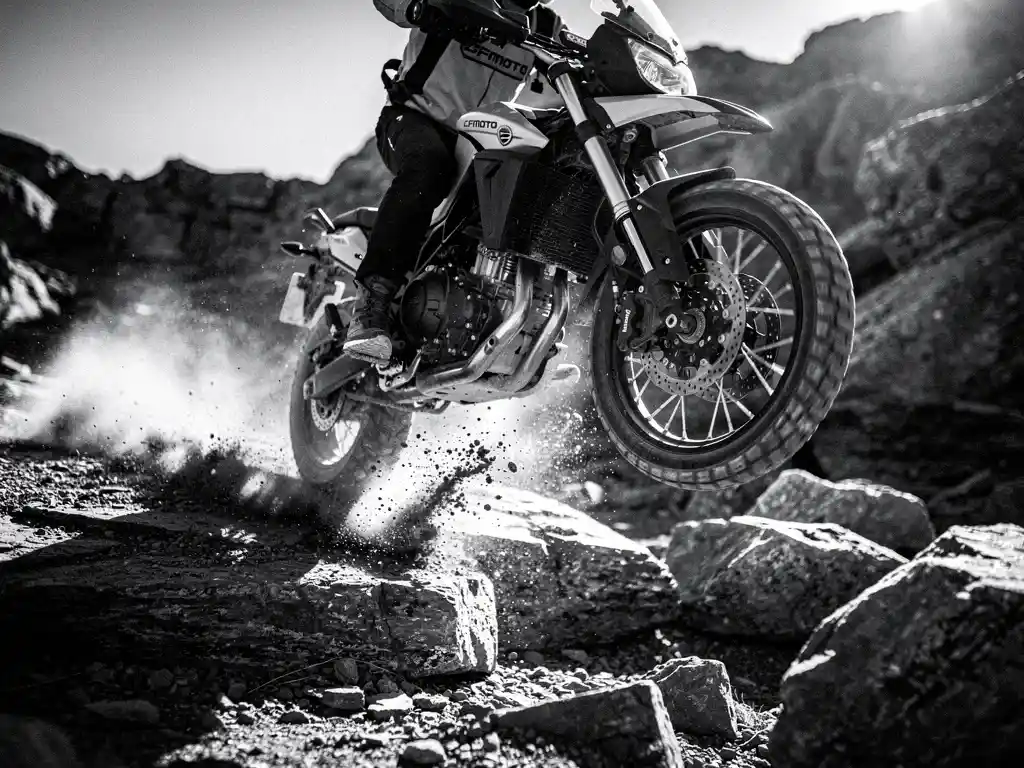
The most impactful suspension changes for the CFMOTO 450 MT off road are upgrading the rear shock spring rate to match your loaded weight, improving front fork damping to handle rough terrain without bottoming out, and fitting a fully adjustable aftermarket unit that lets you dial in compression and rebound independently. The factory suspension on the 450 MT is a capable starting point, but it is tuned as a compromise between road comfort and light trail use rather than genuine off-road performance. The sections below break down exactly which components hold the bike back and what changes deliver the biggest improvement.
Which factory suspension components limit the CFMOTO 450 MT off road?
The main limitations on the CFMOTO 450 MT off road come from the stock rear shock’s limited adjustability and the front forks’ relatively soft spring rates, both of which are calibrated for an average rider on mixed tarmac rather than sustained off-road riding. Under rough terrain conditions, this results in excessive dive on the front end, wallowing at the rear, and a general lack of confidence when the trail gets technical.
The front forks on the 450 MT use a conventional telescopic setup with preload adjustment, but no external compression or rebound damping controls. This means you cannot tune the fork response to different terrain without opening the forks and changing the oil viscosity or springs. On rocky or rutted tracks, the forks can feel vague and reactive rather than controlled and planted.
The rear shock offers slightly more in terms of preload adjustment, but the damping is fixed. For a rider who stays on graded gravel roads, this is manageable. For anyone pushing into more demanding off-road territory, riding two-up, or carrying luggage, the rear shock runs out of capability quickly. It tends to pack down under repeated impacts, losing composure on successive bumps rather than recovering cleanly between them.
What spring rate changes improve off-road handling on the 450 MT?
Fitting a stiffer rear spring and, in many cases, a slightly firmer front spring rate is the single most effective mechanical change you can make to improve CFMOTO 450 MT off-road handling. Spring rate directly controls how far the suspension compresses under load, and the stock springs are typically rated for a rider in the 70 to 80 kg range without luggage.
For off-road use, the goal is to keep the suspension in the middle of its travel range under normal riding conditions, leaving enough stroke to absorb large impacts without bottoming out. If the springs are too soft, the bike sits low in its travel from the start, leaving little reserve for bigger hits. A spring upgrade tailored to your actual weight keeps the geometry correct and the handling predictable.
On the front, many 450 MT riders find that increasing fork oil level by a small amount can partially compensate for soft spring rates by adding air volume resistance near the bottom of the stroke. This is a cost-effective interim measure, but it does not replace a proper spring rate change. A dedicated spring matched to your weight provides consistent performance across the full range of suspension travel rather than just protecting the bottom end.
How does damping adjustment affect the 450 MT on rough terrain?
Damping controls how quickly the suspension compresses and rebounds after an impact, and on rough terrain it is the difference between a bike that feels planted and one that feels chaotic. On the CFMOTO 450 MT, adding external compression and rebound damping adjustment, either through fork internals or an upgraded rear shock, allows you to slow the suspension movement down on fast, choppy surfaces and speed it up for slower, more technical obstacles.
Compression damping resists the initial movement of the suspension into its travel. Too little compression damping on a rough trail causes the forks or shock to dive aggressively into every bump, unsettling the bike. Too much makes the ride harsh and transmits impact energy directly to the chassis. Finding the right balance for your terrain and speed is what external adjustment makes possible.
Rebound damping controls how quickly the suspension returns after being compressed. On the 450 MT with fixed damping, the rebound rate is a compromise. On fast, successive bumps, the suspension can top out between impacts if rebound is too fast, or stay packed down if it is too slow. Adjustable rebound lets you match the recovery speed to the terrain, keeping the wheels tracking the ground rather than skipping over it.
Should you upgrade the front forks or rear shock first on the 450 MT?
For most CFMOTO 450 MT adventure bike riders, upgrading the rear shock first delivers a more immediate and noticeable improvement in off-road capability. The rear shock on the 450 MT is the more compromised component for loaded or off-road riding, and an aftermarket unit with full damping adjustment transforms how the bike handles rough terrain and varying loads.
That said, the right answer depends on your specific riding and the symptoms you are experiencing. If the front end is diving heavily under braking on loose surfaces, or if the forks are bottoming out on drops and compressions, the front end becomes the priority. In practice, the two ends of the bike work as a system, and a significant upgrade to one without addressing the other can create an imbalance.
A useful way to think about it is this: the rear shock sets the platform the whole bike rides on. If it is wallowing or packing down, the chassis attitude is constantly changing and the front end cannot do its job effectively regardless of how good the forks are. Start at the rear, get that dialled in, and then assess whether the front still needs attention. Many riders find the front forks perform noticeably better once the rear is properly sorted.
What aftermarket suspension options are available for the CFMOTO 450 MT?
Aftermarket suspension options for the CFMOTO 450 MT include fully adjustable rear shocks with custom spring rates, fork spring kits, and complete fork rebuild services with upgraded internals. As the 450 MT and its closely related variant, the CFMOTO Ibex 450, continue to grow in popularity across Europe and beyond, specialist suspension manufacturers are developing dedicated solutions for these platforms.
Fully adjustable rear shocks represent the most comprehensive single upgrade available. These units replace the stock shock with a component that offers independent compression and rebound damping adjustment alongside a spring rate matched to your weight and load. The result is a rear end that can be tuned precisely for road, gravel, or technical off-road use without compromise.
For the front forks, the options range from spring replacement kits that improve the basic spring rate, to full cartridge emulator kits that add damping control to the stock fork legs without requiring a complete fork replacement. For riders who want the best possible front-end performance, a full fork service with upgraded internals and correct oil viscosity is the most thorough approach and restores or exceeds the performance of the original components.
How does rider weight and luggage load change the ideal suspension setup?
Rider weight and luggage load have a direct and significant effect on the ideal suspension setup for the CFMOTO 450 MT adventure motorcycle. Every kilogram added to the bike compresses the springs further and increases the demand on damping, which means a setup that works well for a solo rider at 75 kg will feel soft and wallowy for the same rider carrying 20 kg of luggage or riding two-up.
Spring rate is the primary variable that needs to change with load. A spring that is correctly rated for a solo rider keeps the suspension at the right ride height and in the correct part of its travel range. Add significant luggage and that same spring compresses further, lowering the rear of the bike, changing the steering geometry, and reducing the available suspension travel for absorbing impacts. A heavier spring rate, or a shock with a wider preload adjustment range, compensates for this.
Damping also needs to be reconsidered under load. More weight means more energy going into the suspension on each impact, which requires more damping force to control the movement. Riders who regularly switch between solo and loaded touring benefit most from a shock with easy external adjustment, so they can increase compression and rebound damping for loaded days and reduce it for lighter solo riding without tools or specialist knowledge.
How TFX Suspension Helps Improve Your CFMOTO 450 MT Off Road
We specialise in custom suspension solutions built specifically for adventure and dual-sport riders who demand more from their bikes than factory components can deliver. For CFMOTO 450 MT and CFMOTO Ibex 450 riders, we offer a complete range of upgrades designed around your actual weight, riding style, and terrain:
- Custom-rate rear shocks with fully adjustable compression and rebound damping, matched to your loaded weight for consistent performance on and off road
- Front fork spring kits and rebuild services that correct the spring rate and improve damping control without requiring a full fork replacement
- Personalised suspension tuning based on your rider profile, including weight, luggage load, and the type of terrain you ride most
- Maintenance and revision services to restore performance on worn or degraded components and keep your setup performing at its best over time
Our philosophy is simple: do not settle for standard when your riding demands more. Whether you are planning a loaded multi-day adventure or pushing the 450 MT deeper into technical off-road territory, we can build a suspension setup that genuinely matches what you do. Browse our CFMOTO suspension range, explore the full TFX product shop, or use our vehicle finder tool to see exactly what fits your bike. Visit TFX Suspension to get started.
Frequently Asked Questions
How do I know if my CFMOTO 450 MT suspension needs upgrading or just a proper setup?
Start by checking your sag measurements — static sag (bike’s weight alone) and rider sag (with you on board in full gear) should both fall within the manufacturer’s recommended range. If adjusting preload to achieve correct rider sag leaves static sag out of range, or if the bike still wallows, dives, or bottoms out after preload is correctly set, the stock springs are not matched to your weight and an upgrade is the right next step. A suspension that simply needs setup can be corrected with preload alone; one that needs upgrading cannot.
Can I improve the CFMOTO 450 MT's off-road suspension on a tight budget without buying aftermarket parts?
Yes, there are a few low-cost measures worth trying first. Increasing the fork oil level slightly raises the air volume above the oil, adding progressive resistance near the bottom of the stroke to reduce bottoming out — a useful interim fix for soft front forks. On the rear, maximising preload adjustment can help a heavier rider or loaded bike sit at the correct ride height. These are stopgap measures rather than solutions, but they can meaningfully improve confidence on trail while you plan a more comprehensive upgrade.
What are the most common mistakes riders make when upgrading suspension on an adventure bike like the 450 MT?
The most common mistake is choosing a spring rate based on dry body weight alone, without accounting for riding gear, luggage, or a passenger — this typically results in a spring that is still too soft for real-world use. Another frequent error is upgrading one end of the bike significantly without addressing the other, which can create a handling imbalance that feels worse than the original setup. Finally, many riders fit an aftermarket shock and never adjust the damping settings away from the factory default, leaving most of the upgrade’s potential untapped.
How often does the suspension on the CFMOTO 450 MT need servicing, and what happens if it is neglected?
As a general guide, fork oil should be changed every 10,000–15,000 km or annually, whichever comes first, and rear shock seals and fluid should be inspected on a similar schedule — more frequently if the bike sees regular off-road or wet and muddy conditions. Neglected suspension oil degrades and thickens, causing sluggish, inconsistent damping that makes the bike feel unpredictable on rough terrain. Worn seals allow oil to leak and dirt to enter, accelerating internal wear and eventually causing component failure. Regular servicing is especially important after any upgrade investment to protect the performance you have paid for.
Is the suspension setup for two-up riding on the 450 MT very different from a solo off-road setup?
Yes, significantly so. Two-up riding adds substantial weight to the rear of the bike, requiring a noticeably stiffer spring rate and increased compression and rebound damping to maintain correct geometry and controlled movement. A shock with wide external preload and damping adjustment is particularly valuable here, as it allows you to switch between a solo off-road setup and a two-up touring setup quickly and without tools. Trying to use a solo off-road spring rate for two-up riding will result in the rear sitting low, slow rebound recovery, and reduced ground clearance — all of which compromise both comfort and safety.
Will upgrading the suspension on my CFMOTO 450 MT affect how it handles on tarmac and gravel roads?
A well-matched suspension upgrade should improve performance across all surfaces, not just technical off-road terrain. The key is choosing a spring rate and damping setup calibrated to your actual weight and riding style rather than simply fitting the stiffest available option. A correctly spec’d aftermarket shock with adjustable damping gives you a setup that handles rough trails confidently while remaining composed and comfortable on tarmac and gravel — in many cases, riders report that road manners improve alongside off-road capability because the bike is no longer wallowing or diving under normal riding conditions.
How long does it take to fit an aftermarket rear shock on the CFMOTO 450 MT, and can it be done at home?
Fitting a replacement rear shock on the 450 MT is a straightforward job that can be completed with basic tools and a paddock stand or centre stand to support the bike. The process involves removing the stock shock’s mounting bolts, swapping the unit, and torquing the new shock to the manufacturer’s specification. It is well within the capability of a mechanically confident home mechanic. However, if the new shock requires spring preload or damping to be set at installation, it is worth taking a few minutes to dial in the initial settings based on your weight before your first ride rather than leaving everything at the factory default.
Configure Your Motorcycle Suspension
Find the correct TFX suspension setup for your motorcycle in less than 60 seconds.
Start ConfigurationRelated Articles
- Waarom moet ik de sag opnieuw controleren voordat ik op motorvakantie ga?
- Are aftermarket springs worth it on the CFMOTO 450 MT adventure motorcycle?
- What suspension settings affect small bump compliance on adventure motors?
- How do you plan an adventure motor trip?
- How do you choose adventure bike tires for street vs off-road?
