

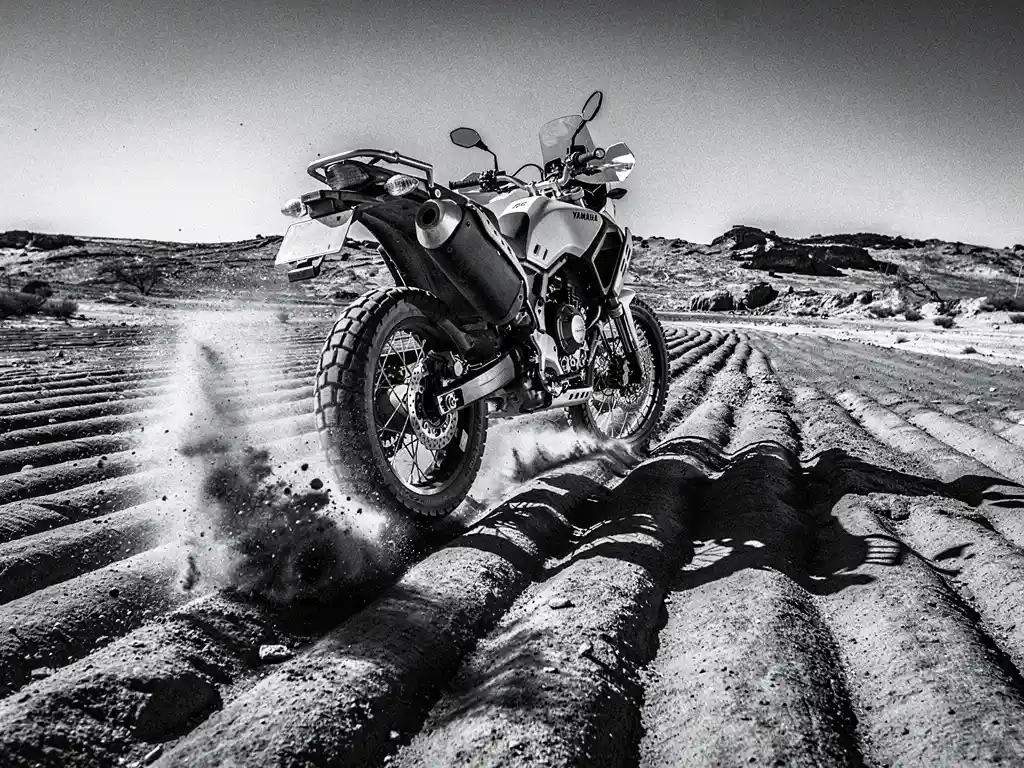
The Yamaha Ténéré 700 bounces on corrugated dirt roads primarily because its stock suspension is tuned for a broad range of riders and conditions, which means the damping is too soft to absorb the rapid, repetitive impacts of washboard surfaces at typical riding speeds. Adjusting compression damping and finding the right speed through corrugations are the two fastest ways to reduce the bounce. This article works through every related question, from basic setup tweaks to knowing when a full suspension upgrade makes sense.
Why does the Ténéré 700 bounce so badly on washboard roads?
The Ténéré 700 bounces on corrugated roads because the factory suspension lacks sufficient compression damping to control the rapid, rhythmic strikes that washboard surfaces produce. Each ridge hits the wheel before the previous compression has fully recovered, causing the suspension to enter a resonance cycle where the bouncing compounds rather than damping out.
The Yamaha Ténéré 700 adventure bike ships with a relatively compliant suspension setup designed to suit a wide range of riders straight from the dealership. That broad-spectrum tuning is a sensible commercial decision, but it creates a specific weakness on corrugated tracks. Washboard surfaces generate a frequency of impacts that can match or approach the natural resonant frequency of the suspension system. When that happens, energy builds rather than dissipates, and the bike begins to skip, float, or pogo in a way that feels almost uncontrollable.
There are a few contributing factors worth understanding:
- Low compression damping: Stock settings allow the fork and shock to compress quickly, which feels plush on single bumps but cannot recover fast enough between successive corrugations.
- Spring rate: The factory spring rate is a middle-ground compromise. Lighter or heavier riders will find themselves outside the intended working range, making resonance worse.
- Unsprung weight and tire pressure: Higher tire pressures increase the rigidity of the contact patch, transmitting more corrugation energy directly into the suspension rather than absorbing it at the tire.
Understanding these root causes makes it much easier to target the right fix, whether that is a simple adjustment or something more involved.
What suspension settings reduce corrugation bounce on the T7?
To reduce corrugation bounce on the Ténéré 700, increase compression damping on both the front fork and rear shock, check that sag is set correctly for your weight, and lower tire pressure slightly to let the tire absorb more of the initial impact. These three adjustments together can dramatically change how the bike handles washboard terrain.
Start with sag. If your static sag is outside the recommended range, the suspension is already working from a compromised position before you even hit a rough track. For the T7, rear sag is typically set between 95 and 105 mm for a solo rider. Front sag should sit around 30 to 35 mm. Measure both with your full riding gear on.
Once sag is correct, add compression damping in small increments. Turn the compression adjuster clockwise by two or three clicks at a time and test on the same section of road. You are looking for the point where the bike feels controlled without becoming harsh over isolated bumps. Too much compression damping will make the fork or shock pack down on repeated hits, so the goal is a balance rather than the maximum setting.
Tire pressure is an underrated variable. Dropping pressure by 3 to 5 psi from your road setting increases the tire’s ability to conform to the surface and absorb some of the corrugation energy before it ever reaches the suspension. On a Yamaha Ténéré 700 off-road bike, running 20 to 22 psi at the rear on a dirt track is reasonable in most conditions.
Does riding speed affect how much the T7 bounces on corrugations?
Yes, riding speed has a significant effect on corrugation bounce. At low speeds, the T7 tends to crash through each ridge individually. At moderate speeds, the frequency of impacts often matches the suspension’s resonant frequency, producing the worst bounce. At higher speeds, the suspension can skim across the tops of the corrugations, which reduces the amplitude of each hit.
This phenomenon is well known among experienced off-road and adventure riders. There is often a “sweet spot” speed on corrugated tracks where the bike settles and becomes easier to manage. That speed varies depending on the spacing and depth of the corrugations, your suspension setup, and your total loaded weight.
The practical implication is that slowing down is not always the safest response to a bouncing T7. If the road conditions and your skill level permit, gradually increasing speed until the bike smooths out can be a legitimate technique. That said, higher speeds demand more attention, more trail ahead for reaction time, and a suspension that is properly set up to handle the increased demands. Riding faster on corrugations with worn or poorly adjusted suspension is not a solution.
What’s the difference between aftermarket shock absorbers and a suspension tune for the T7?
A suspension tune adjusts the existing components, while aftermarket shock absorbers replace them entirely. A tune is the right starting point if the stock hardware is in good condition and the main issue is incorrect settings for your weight and riding style. Aftermarket shocks are worth considering when the stock components cannot deliver the damping range or spring rate your riding demands.
The Yamaha Ténéré 700 dual sport bike comes with a KYB front fork and a KYB rear shock. These are competent units, but they have a limited adjustment range and are not designed with the specific needs of a loaded adventure rider or aggressive off-road use in mind. A professional suspension tune involves measuring your sag, testing the damping response, and dialing the settings as close to optimal as the hardware allows. It can also involve revalving the internals, which changes the damping characteristics more fundamentally than external clickers can.
Aftermarket shock absorbers, by contrast, are built with a wider adjustment range, higher-quality seals, better heat management, and often a spring rate selected specifically for your weight rather than the factory average. They allow a level of customisation that stock units simply cannot match. The trade-off is cost and the need to choose the right unit for your use case.
In practical terms, if your T7 bounces on corrugations but behaves reasonably well on other surfaces, start with a proper tune. If you ride heavily loaded, travel long distances on rough tracks, or find that even a well-tuned stock setup still leaves you fighting the bike, aftermarket hardware is the more durable solution.
How does rider weight and luggage load change corrugation behavior?
Rider weight and luggage load directly affect how the Ténéré 700 responds to corrugations by changing the effective spring rate and damping requirements. A heavier total load compresses the suspension further into its travel, reducing the available stroke to absorb impacts and shifting the resonant frequency of the system.
The factory spring rate on the T7 is designed around an average rider weight, typically in the range of 75 to 80 kg without gear. If you weigh significantly more or less, or if you regularly carry panniers, a tank bag, and camping equipment, the suspension is operating outside its intended range. On corrugated roads, this shows up as either a harsh, bottoming sensation or an excessive bounce that the damping cannot control.
A few specific effects to be aware of:
- Heavier loads lower the ride height, which reduces suspension travel and makes bottoming more likely on deep corrugations.
- Rear-biased loading puts more stress on the rear shock and can cause the front to feel light and vague on rough terrain.
- Dynamic weight shifts during braking or acceleration on corrugated tracks become more pronounced with luggage, requiring more deliberate and smooth throttle and brake inputs.
If you regularly ride the Yamaha Ténéré 700 adventure motorcycle with significant luggage, adjusting preload to compensate for the extra weight is the minimum step. Ideally, the spring rate should be matched to your total loaded weight, which is something a suspension specialist can assess properly.
When should you consider a full suspension upgrade for the Ténéré 700?
Consider a full suspension upgrade for the Ténéré 700 when stock components have been properly tuned and still cannot deliver the control or comfort you need, when you ride with significant loads regularly, or when the existing hardware is worn and due for replacement anyway. Replacing worn components with aftermarket units is almost always more cost-effective than rebuilding old stock parts.
There are clear signals that indicate the stock suspension has reached its limits:
- Persistent bouncing on corrugations even after sag and damping adjustments
- Bottoming out under load on trails that should be within the bike’s capability
- Inconsistent damping feel, particularly after longer rides when heat builds in the fluid
- Fork seals or shock seals that need frequent replacement, which often indicates worn internals
- A noticeable improvement in confidence and control when riding borrowed or demo bikes with aftermarket suspension
For adventure riders planning extended tours on the Yamaha Ténéré 700 adventure bike, a suspension upgrade is also worth considering proactively rather than reactively. Failing suspension mid-tour in a remote area is a much more expensive problem than investing in quality components before you leave.
How TFX Suspension Helps With Corrugation Bounce on the Ténéré 700
We specialise in exactly the kind of problem the Ténéré 700 presents on corrugated roads: a capable adventure bike let down by suspension that was never designed for the specific demands of loaded, long-distance off-road riding. Our approach is built around custom tuning rather than off-the-shelf compromises, which means every solution is matched to your weight, your luggage setup, and the terrain you actually ride.
Here is what we offer for Ténéré 700 riders dealing with corrugation bounce:
- Custom-tuned aftermarket shock absorbers from our Traveler and Xtreme series, selected and set up for your total loaded weight and riding style
- Professional suspension setup and revalving for riders who want to get more from their existing hardware before committing to a full replacement
- Load-specific spring rate selection for riders who regularly carry panniers, a passenger, or expedition-weight luggage
- Ongoing service and maintenance so your suspension stays in peak condition across long tours and demanding terrain
If you are ready to stop fighting your T7 on rough tracks, find your vehicle on our platform to see the options available for the Ténéré 700. You can browse our full range of suspension components in the TFX shop, or visit TFX Suspension to learn more about how we build suspension systems that are designed around the rider, not the average.
Frequently Asked Questions
Can I fix corrugation bounce on my T7 myself, or do I need a professional?
Most of the initial adjustments — setting sag, adding compression damping, and lowering tire pressure — are straightforward DIY tasks that require only basic tools and a tape measure. However, if you need to revalve the internals or select a new spring rate for your loaded weight, a suspension specialist will get you to the right setup far faster and more accurately than trial and error alone. A good starting point is to work through the sag and damping adjustments yourself first; if the bike still misbehaves after those changes, that’s the signal to book a professional assessment.
How do I know if my T7's suspension is worn out versus just incorrectly set up?
Incorrect setup typically shows up as consistent, predictable behaviour — bouncing at a specific speed, bottoming under a known load, or a harsh feel that goes away when you back off damping. Worn suspension tends to feel inconsistent: damping that fades after 20–30 minutes of hard riding, oil weeping from fork seals, a clunking or knocking sensation through the stroke, or a noticeable improvement after the components cool down. If your settings are correct but the bike still misbehaves in these inconsistent ways, worn internals are the more likely culprit.
What's the best way to set sag on the Ténéré 700 if I always ride with luggage?
Always measure sag in the configuration you actually ride in — full gear, fuel load, and all luggage attached. Measuring unloaded and then adding weight afterwards defeats the purpose, because the spring and damping are working from a completely different position in real-world use. If adding your typical luggage pushes sag beyond the recommended range even at maximum preload, that’s a clear indicator that the factory spring rate is too soft for your loaded weight and a heavier spring should be considered.
Are there specific aftermarket suspension brands or models that are well-regarded for the T7 on corrugated roads?
Several aftermarket options are commonly used on the Ténéré 700, including Öhlins, WP, and Bitubo units, as well as TFX Suspension’s own Traveler and Xtreme series, which are built specifically for loaded adventure riding. The most important factor isn’t the brand name alone — it’s whether the unit is valved and sprung for your actual total weight and riding style. A quality shock set up for the wrong rider will still underperform, so prioritise suppliers who offer weight-specific tuning rather than a generic off-the-shelf fitment.
Will lowering tire pressure for corrugations cause any problems on mixed terrain?
Running lower pressures on dirt and corrugated tracks is safe and effective within reasonable limits, but you should return to road pressures before riding extended sections of tarmac. Lower pressures on pavement increase heat buildup in the tire carcass, reduce handling precision, and raise the risk of a pinch flat if you hit a sharp edge at speed. A small digital tire gauge and a compact pump or CO2 inflator are worth carrying so you can adjust pressure at the start and end of each off-road section without it becoming a barrier to doing so.
Does the World version of the Ténéré 700 have better corrugation handling than the standard model?
The Ténéré 700 World Raid ships with a larger-diameter front fork and a revised rear shock with slightly more travel, which does give it a modest advantage in handling rough terrain out of the box. However, the same fundamental limitation applies — the factory tune is still a broad-spectrum compromise, and riders outside the average weight range or carrying significant loads will still benefit from a proper setup or upgrade. The World Raid’s hardware is a better starting point, but it is not a complete solution for serious corrugated touring.
How often should I service my T7's suspension if I ride a lot of rough tracks?
As a general guideline, fork oil and rear shock fluid should be inspected or replaced every 10,000–15,000 km for road-biased use, but that interval should be shortened to around 5,000–8,000 km if you regularly ride corrugated or heavily rutted tracks. Degraded suspension fluid loses its viscosity and damping consistency, which is one of the main reasons a bike that felt great at the start of a tour feels vague and bouncy by the end. Checking seals for weeping and cleaning dust wipers after every dusty ride are simple habits that significantly extend component life.
Configure Your Motorcycle Suspension
Find the correct TFX suspension setup for your motorcycle in less than 60 seconds.
Start Configuration