

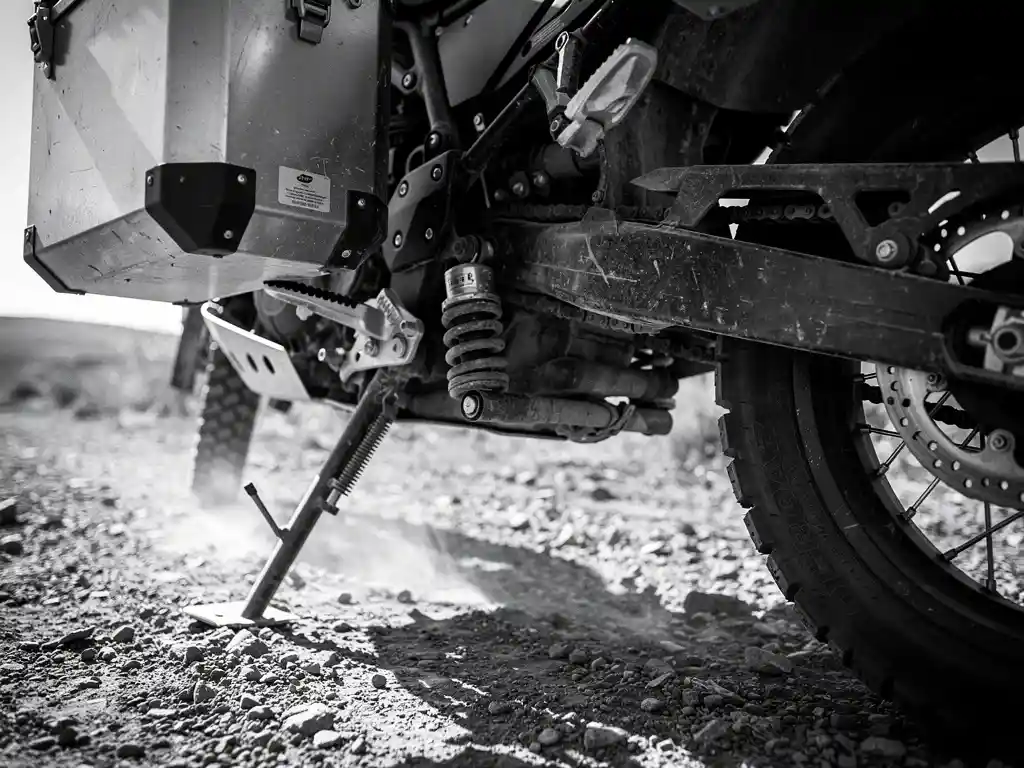
The Yamaha Ténéré 700 suspension bottoms out with heavy panniers because the stock rear spring is tuned for a solo rider without luggage, and adding 20 to 30 kilograms of packed panniers and a top box pushes the suspension well beyond its designed load range. The result is a rear end that sits too low in its travel, loses ground clearance, and runs out of stroke over bumps and ruts. The sections below break down exactly why this happens, how much weight triggers it, and what you can do about it.
What actually causes a suspension to bottom out under load?
Suspension bottoms out when the available stroke is fully compressed and the damper or spring reaches its mechanical limit. Under heavy load, the static sag increases dramatically, which means the suspension starts every bump from a position much closer to full compression. When the remaining travel is insufficient to absorb the impact, the suspension hits its end stop hard.
There are two forces working against you simultaneously when you load a Yamaha Ténéré 700 adventure bike with full luggage. First, the added weight compresses the spring beyond its design point, reducing the amount of usable travel. Second, the damping valving inside the shock is calibrated for a specific weight range. When that range is exceeded, the oil flows too freely through the piston, and the damper cannot slow the compression stroke fast enough to prevent bottoming.
The sensation riders notice is a sudden, jarring thud at the end of the suspension travel, often accompanied by a loss of steering control or a brief moment where the rear wheel skips sideways. On a loaded adventure motorcycle crossing rough terrain, this is not just uncomfortable, it is a genuine safety concern because the tyre momentarily loses contact with the ground.
Is the Yamaha Ténéré 700 suspension underpowered for adventure touring?
The Yamaha Ténéré 700 dual sport bike ships with a competent suspension setup for its class, but it is calibrated for solo riding and moderate off-road use. For serious adventure touring with full luggage, a passenger, or both, the stock components are genuinely undersized in terms of spring rate and damping range. This is a design compromise, not a flaw.
The front fork uses non-adjustable conventional tubes on the base model, offering only spring preload adjustment on some variants. The rear KYB shock provides preload adjustment and limited rebound damping control, but the spring rate is on the softer side to deliver a compliant feel for the target demographic of everyday adventure riders. That softness becomes a liability the moment you strap on a 15-kilogram rear pannier set and a loaded top box.
Yamaha designed the Ténéré 700 adventure motorcycle to be accessible and fun rather than expedition-ready out of the box. Riders who push into long-distance loaded touring quickly discover that the stock suspension is the first component that needs attention. This is a well-documented pattern across the adventure riding community and not unique to the Ténéré 700 off road bike. Most mid-weight adventure motorcycles in this segment share the same compromise.
How much weight does it take to make the Ténéré 700 bottom out?
The Yamaha Ténéré 700 adventure motorcycle has a rated payload capacity that includes rider, passenger, accessories, and luggage. In practical terms, most riders report noticeable suspension sag and bottoming sensitivity once total added weight exceeds roughly 25 to 35 kilograms above the solo rider baseline. This threshold varies with rider weight, road surface, and speed.
A typical loaded touring setup accelerates toward that threshold quickly. Consider a common adventure touring configuration:
- Two side panniers fully packed: 15 to 20 kilograms
- Top box with gear: 8 to 12 kilograms
- Tank bag and accessories: 3 to 5 kilograms
- Heavier rider (over 85 kilograms): additional spring compression beyond design point
Add those figures together and you can easily be operating 30 or more kilograms over the suspension’s optimal load window. On smooth tarmac, this may only feel like sluggish handling. On gravel tracks, corrugated dirt roads, or rocky trails, the same load will cause repeated bottoming and can damage the shock internals over time through cavitation and oil aeration.
Can preload adjustment fix bottoming out on the Ténéré 700?
Increasing preload on the Yamaha Ténéré 700 rear shock can partially address bottoming out under load, but it is not a complete solution. Preload adjustment raises the ride height and restores some static sag, which gives the suspension more usable travel. However, it does not change the spring rate or damping characteristics, so the fundamental mismatch between load and calibration remains.
Here is what preload adjustment can and cannot do for a loaded Ténéré 700 adventure bike:
- Can do: Restore correct static sag (typically 25 to 35mm for the rear on a loaded adventure motorcycle)
- Can do: Raise the rear ride height, improving ground clearance and cornering angle
- Can do: Reduce the frequency of bottoming on moderate bumps
- Cannot do: Increase the spring rate to match a heavier load
- Cannot do: Improve damping control through the compression stroke
- Cannot do: Stop bottoming on sharp impacts or deep ruts when the spring is already overwhelmed
The practical advice is to max out the preload adjustment as a first step and reassess. If the bike still bottoms out on terrain you regularly ride, or if the ride quality feels harsh and unsettled even after adjustment, the stock spring rate is the limiting factor and no amount of preload tuning will resolve that.
What suspension upgrades stop the Ténéré 700 from bottoming out?
The most effective upgrades to stop a Yamaha Ténéré 700 motorcycle from bottoming out under load are a stiffer rear spring matched to your total system weight, a rear shock with adjustable compression damping, and optionally upgraded fork springs with heavier oil. Together, these changes address both the spring rate mismatch and the damping inadequacy that cause bottoming.
Rear shock replacement
Replacing the stock KYB rear shock with an aftermarket unit built for loaded adventure touring is the single highest-impact upgrade. A quality aftermarket shock will offer a spring rate matched to your actual loaded weight, full compression and rebound damping adjustment, and better internal valving designed to handle variable loads. This transforms the Ténéré 700 dual sport bike from a compromised tourer into a genuinely capable expedition machine.
Fork spring and oil upgrades
The front end of the Ténéré 700 off road bike benefits significantly from stiffer progressive fork springs and a viscosity increase in the fork oil. The stock springs are soft enough that a loaded front end dives sharply under braking and compresses too easily over square-edged bumps. Heavier springs combined with slightly thicker oil slow the compression rate and give the front wheel better tracking on rough surfaces.
When should you upgrade versus just adjusting the stock suspension?
You should upgrade the suspension on your Yamaha Ténéré 700 adventure motorcycle when preload and damping adjustments no longer restore acceptable sag, when the bike bottoms out repeatedly on terrain within your normal riding envelope, or when your total loaded weight consistently exceeds the stock suspension’s design range. Adjustment is the right first step. Replacement is the right step when adjustment runs out of range.
A few clear signals that adjustment alone is no longer enough:
- The rear shock preload is already at maximum and static sag still exceeds 40mm under load
- You feel bottoming on bumps that would not have caused it when riding unloaded
- The bike wallows or feels vague in corners when carrying luggage
- Rebound damping adjustments no longer control the spring’s return speed effectively
- You regularly ride with a passenger and luggage simultaneously
If your riding is primarily light day trips with minimal luggage and a solo rider of average weight, the stock suspension with proper preload adjustment will serve you well. The moment your use case shifts toward multi-day tours, heavy luggage, variable terrain, or a heavier rider, the investment in upgraded components pays for itself in safety, comfort, and reduced wear on the rest of the motorcycle.
How TFX Suspension Helps With Ténéré 700 Bottoming Out
We build suspension systems specifically designed to solve the load-sensitivity problems that adventure riders face on bikes like the Yamaha Ténéré 700. Rather than offering a generic off-the-shelf replacement, we match every component to your actual riding weight, luggage setup, terrain preference, and riding style. Here is what we provide:
- Custom-sprung rear shocks from our Traveler and Freelexer series, with spring rates calculated for your real loaded weight rather than a factory average
- Full compression and rebound damping adjustment so you can fine-tune the setup as your load changes between a solo day ride and a fully loaded expedition
- Fork spring and oil recommendations to balance the front end with the upgraded rear, preventing the front dive and understeer that often develops after a rear-only upgrade
- Custom tuning and setup service where our technicians dial in the settings before the shock ships, so it performs correctly from the first ride
- Full serviceability so your suspension can be rebuilt and revalved as your riding evolves, rather than replaced entirely
If your Ténéré 700 is bottoming out under load and preload adjustments have not solved the problem, the right upgrade is waiting for you. Find your vehicle to see the suspension options built for your specific bike, browse our full product range, or visit TFX Suspension to learn more about how we approach custom adventure suspension.
Frequently Asked Questions
How do I measure static sag on my Ténéré 700 to know if the suspension is properly set up for my loaded touring weight?
To measure static sag, you need three measurements: free sag (bike on a stand with no rider or load), laden sag (rider and full luggage on the bike, feet on pegs), and the difference between the two. For a loaded adventure touring setup on the Ténéré 700, you’re aiming for roughly 25–35mm of rear static sag with your full touring weight on board. Measure from a fixed point on the rear subframe to the axle, and take readings with a helper holding the bike upright. If your laden sag exceeds 40mm even at maximum preload, that’s a clear signal the stock spring rate is too soft for your load.
Will fitting a heavier rear spring make the Ténéré 700 ride harshly when I'm unloaded or on day trips without luggage?
A spring rate that’s correctly matched to your loaded weight will feel firmer than stock when unloaded, but a well-chosen progressive spring or a shock with adjustable preload can significantly reduce the trade-off. The key is selecting a spring rate matched to the midpoint of your typical load range rather than your maximum, and pairing it with adjustable damping so you can soften the setup for light solo rides. Many Ténéré 700 tourers find the slightly firmer unloaded feel is a worthwhile compromise given how dramatically the loaded performance improves.
Can luggage placement affect how badly the suspension bottoms out, and is there a smarter way to pack panniers?
Yes, luggage placement has a significant effect on suspension behaviour. Mounting heavy items low in the panniers and as close to the bike’s centre of gravity as possible reduces the leverage effect on the rear suspension and improves overall stability. Avoid stacking heavy gear in a top box if you can redistribute it into the lower side panniers instead, since top box weight sits high and far back, amplifying the load on the rear spring. Even with optimal packing, if your total weight exceeds the stock suspension’s design range, smart packing reduces the problem but doesn’t eliminate it.
How much does a quality aftermarket rear shock for the Ténéré 700 typically cost, and is it worth the investment?
A quality aftermarket rear shock for the Yamaha Ténéré 700, such as those from TFX, Öhlins, or Bitubo, typically ranges from around £300 to £700 or more depending on the specification and adjustability level. For riders who regularly tour with full luggage, the investment is generally considered worthwhile because it directly addresses safety (preventing wheel skip and loss of traction on rough terrain), reduces fatigue on long days, and protects the rest of the drivetrain and frame from the repeated impacts that a bottoming stock shock transfers directly into the chassis. Spread over several years of touring, the cost per kilometre is minimal compared to the improvement in performance and confidence.
Does the front suspension on the Ténéré 700 also need upgrading, or is the rear shock enough on its own?
In most loaded touring scenarios, the rear shock is the priority upgrade, but upgrading the rear without addressing the front can introduce a new imbalance. A stiffer rear combined with soft stock forks can cause pronounced front dive under braking, understeer in corners, and a nose-low attitude that affects handling geometry. Upgraded fork springs and a viscosity-appropriate fork oil are a relatively affordable complement to a rear shock upgrade and help the bike feel balanced and predictable across the full range of loaded riding conditions. If budget is a constraint, do the rear first, then assess the front on your next tour.
What common mistakes do Ténéré 700 riders make when trying to fix suspension bottoming before they consider an upgrade?
The most common mistake is maxing out rear preload without checking or adjusting rebound damping, which results in a suspension that sits higher but rebounds too quickly, causing a bouncy, unsettled feel that can be mistaken for the spring being too stiff. Another frequent error is adding preload to compensate for a worn or oil-degraded stock shock, which masks the real problem rather than solving it. Riders also sometimes add luggage weight gradually over multiple trips without re-checking sag, not realising how far outside the optimal window the suspension has drifted until bottoming becomes severe.
How do I know if my stock Ténéré 700 shock is already worn or damaged from previous bottoming, and should that change my upgrade decision?
Signs of a worn or internally damaged stock shock include oil weeping from the seal around the shaft, a noticeably bouncy or wallowing ride even when lightly loaded, and a clunking or knocking sensation at the end of the compression stroke that feels different from a clean bottom-out. If the shock has been subjected to repeated hard bottoming under load, internal cavitation and oil aeration may have already degraded its damping performance. In that case, attempting further adjustment is unlikely to help, and a direct replacement with an upgraded unit is the most practical and cost-effective path forward.
Configure Your Motorcycle Suspension
Find the correct TFX suspension setup for your motorcycle in less than 60 seconds.
Start ConfigurationRelated Articles
- Wanneer is een upgrade van de voorvork nodig na montage van een nieuwe achterdemper?
- Can better suspension make the CFMOTO 450 MT motor more confidence inspiring off road?
- What USB and power options does CFMOTO 450 MT offer?
- When should adventure motor suspension linkages be serviced?
- How do you adjust preload for a passenger on adventure motors?
