

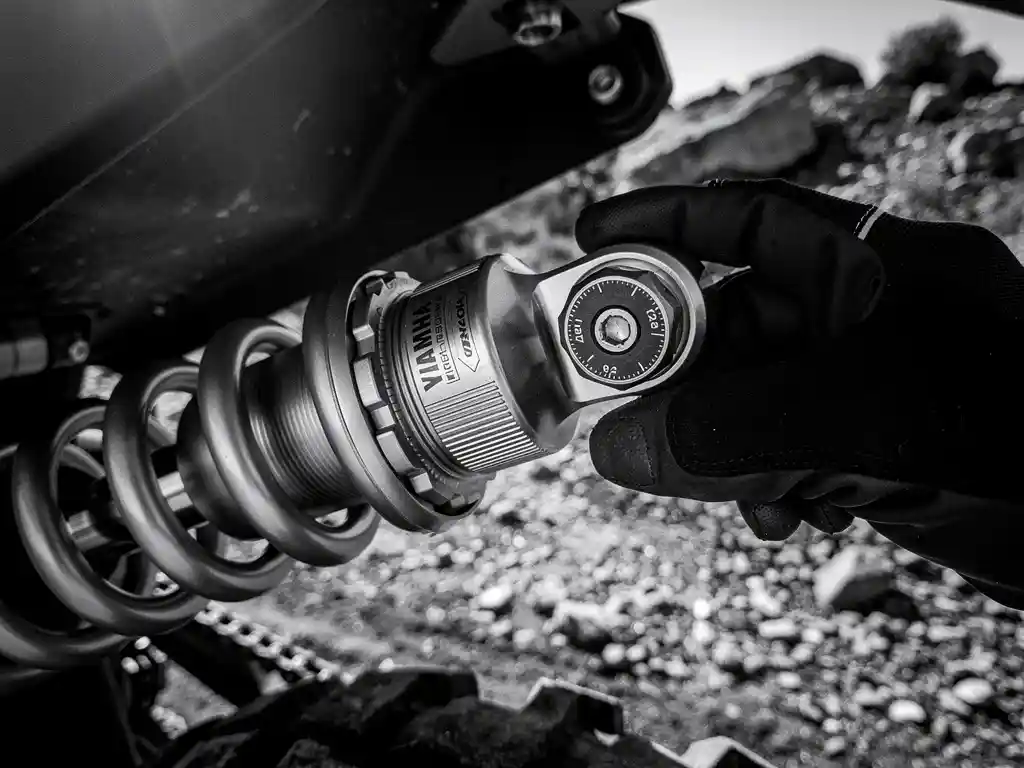
To set compression damping on the Yamaha Ténéré 700 for off-road riding, start with the clickers fully open, then add clicks of compression in small increments until the suspension feels controlled without feeling harsh over rough terrain. For most off-road conditions, a setting between 5 and 10 clicks from fully open works well as a baseline. The exact setting depends on your weight, riding style, and the type of terrain you are tackling.
The Yamaha Ténéré 700 adventure bike ships with capable but compromise-oriented suspension from the factory, which means there is real performance to unlock through thoughtful adjustment. This guide walks through everything you need to know, from understanding what compression damping actually does to recognising when the stock setup has reached its limits.
What does compression damping actually do on the Ténéré 700?
Compression damping controls how quickly the suspension compresses when it hits a bump, dip, or impact. On the Yamaha Ténéré 700, it regulates the resistance the fork legs and rear shock offer as they move inward under load. Too little compression damping and the suspension dives or bottoms out. Too much and the bike feels rigid, transmitting impacts directly to the rider.
Think of compression damping as the gatekeeper between the terrain and your body. When you ride the Yamaha Ténéré 700 off road, the front forks and rear shock are constantly absorbing energy from rocks, roots, ruts, and jumps. Compression damping determines how that energy is managed during the inward stroke of the suspension travel.
On the T7 specifically, compression damping works alongside spring preload and rebound damping to create the complete suspension picture. Adjusting compression alone changes how the bike handles initial impacts, but the three elements interact closely. A well-set compression damping adjustment makes the dual sport bike feel planted and predictable, giving you confidence to push further on technical trails.
Where are the compression damping adjusters on the Yamaha T7?
On the Yamaha Ténéré 700, the front compression damping adjuster is located at the top of the right fork leg, typically a slotted screw that you turn with a flathead screwdriver. The rear compression damping adjuster sits on the shock body itself, usually accessible near the lower mounting point. Both use a click-based system where each click represents a measurable change in damping force.
Before making any adjustments, count the total number of available clicks by turning the adjuster gently clockwise until it stops, then counting back counterclockwise. This gives you the full range and helps you establish a reference point. Always note your starting position before changing anything so you can return to it if a new setting does not work out.
The rear shock on the stock Yamaha Ténéré 700 adventure motorcycle offers more limited adjustability than aftermarket options. Depending on the production year of your T7, the exact adjuster location can vary slightly, so checking your owner’s manual for the precise position on your specific model is always a good idea before you start turning anything.
What compression damping settings work best for off-road riding on the T7?
For off-road riding on the Yamaha Ténéré 700, a good starting point is 5 to 8 clicks from fully open on the front forks and a similar range on the rear shock. This gives the suspension enough freedom to absorb irregular terrain while maintaining enough control to prevent excessive dive or wallowing. Softer settings suit loose, technical trails; firmer settings suit high-speed gravel or hardpack.
Front fork compression settings for off road
When riding the T7 on loose dirt, sand, or rocky trails at moderate speeds, opening the front compression adjuster closer to fully open allows the forks to move freely and follow the ground. This improves traction and reduces arm fatigue. On faster off-road tracks where you are carrying more speed over bumps, adding a few extra clicks of compression prevents the forks from diving excessively mid-corner or under braking.
Rear shock compression settings for off road
The rear shock on the Yamaha Ténéré 700 off-road bike benefits from slightly more compression damping than the front in many off-road situations, particularly when the bike is loaded or when riding at higher speeds. A firmer rear helps prevent the back end from squatting aggressively under acceleration out of corners. Start with 6 to 10 clicks from fully open and adjust from there based on how the bike feels on your chosen terrain.
How does rider weight and luggage affect compression damping on the T7?
Heavier riders and additional luggage increase the load on the suspension, which means the stock compression damping settings will feel softer than they would for a lighter rider with no luggage. If you weigh significantly more than the average rider the bike is tuned for, or if you are carrying panniers and a top box for an adventure tour, you will need to add compression damping to compensate for the increased load.
As a practical guide, for every significant increase in total system weight, whether from a heavier rider, a pillion passenger, or loaded luggage, add 2 to 3 clicks of compression damping on both front and rear as a starting adjustment. Then test ride and fine-tune from there. This prevents the suspension from using up its travel too quickly under the extra weight.
The Yamaha Ténéré 700 adventure bike is frequently used for multi-day touring with full luggage, which creates a very different dynamic compared to a solo day ride. Riders who regularly switch between loaded touring and lightweight day riding benefit enormously from learning their preferred settings for each scenario and keeping a note of them. A few minutes of adjustment at the start of a trip pays dividends over hundreds of kilometres.
How do you know if your compression damping is set too hard or too soft?
If your compression damping is too soft, the Yamaha Ténéré 700 will feel like it is wallowing or diving excessively, the front end may tuck under hard braking, and the rear may squat deeply under acceleration. If it is too hard, the bike will feel harsh and skittish over rough terrain, the wheels will skip rather than tracking the ground, and your hands and arms will fatigue quickly from transmitted vibration.
A simple test for the front is to push down firmly on the handlebars while standing still. The forks should compress smoothly and return without bouncing. If they slam back up quickly, rebound may also need attention. If they feel like they barely move, compression is likely too stiff for off-road use.
On the trail, pay attention to these signals:
- Too soft: The bike bottoms out on larger hits, the front dives under braking, the rear squats heavily under power, and the bike feels unpredictable over whoops or repeated bumps.
- Too hard: The bike feels nervous and skips over rough surfaces, the tyres lose contact with the ground frequently, your arms absorb impacts instead of the suspension, and the ride feels exhausting rather than controlled.
- About right: The suspension moves freely but feels controlled, the tyres stay in contact with the ground through bumpy sections, and the bike inspires confidence rather than demanding constant correction.
When should you upgrade beyond the stock T7 compression damping?
You should consider upgrading beyond the stock Yamaha Ténéré 700 suspension when the factory adjuster range no longer covers your needs, when you are riding significantly more demanding terrain than the bike was designed for, or when you consistently find yourself at the extreme ends of the adjustment range without reaching a satisfying result. Riders who are heavier than average, ride aggressively off road, or tour with heavy loads regularly will often outgrow the stock setup.
The stock suspension on the Yamaha Ténéré 700 dual sport bike is genuinely capable for mixed riding, but it is engineered as a broad compromise. The spring rates, damping range, and overall travel are calibrated for a wide range of riders and conditions. Once you know exactly what you need from your suspension, a custom-tuned or upgraded system can unlock a level of precision and confidence that the factory setup simply cannot match.
Signs that you have reached the limits of the stock setup include persistent bottoming out despite maximum compression settings, a feeling that the bike never quite handles the way you want regardless of adjustments, or recurring discomfort and fatigue on longer off-road rides. At that point, the adjustment range itself has become the limiting factor rather than your technique.
How TFX Suspension Helps With Ténéré 700 Compression Damping
We specialise in building suspension systems that go beyond the limitations of factory setups. For Yamaha Ténéré 700 riders who want more than the stock compression damping range can offer, we provide fully custom-tuned solutions built around your specific weight, riding style, and terrain. Here is what we offer:
- Custom-tuned shocks and fork springs: Matched to your exact rider weight and load configuration for accurate compression damping from the first ride.
- Wider adjustment range: Our aftermarket units offer a broader and more precise compression damping range than the stock T7 components, giving you real control over how the bike behaves on and off road.
- Full service and revalving: Whether your existing suspension needs a refresh or a complete performance overhaul, we handle the full process.
- Adventure and touring-specific tuning: We understand the demands of long-distance riding with luggage and can set up your T7 to handle loaded touring and unladen trail riding with equal confidence.
Our philosophy is simple: do not settle for standard. If you are ready to get the most out of your Yamaha Ténéré 700 adventure motorcycle, find your vehicle on our platform to explore compatible options, browse our full range at the TFX suspension shop, or visit TFX Suspension to learn more about what we build and how we can help.
Frequently Asked Questions
Should I adjust compression damping and rebound damping at the same time on the Ténéré 700?
It is best to adjust one setting at a time so you can clearly identify what each change does to the bike’s behaviour. Start by dialling in your compression damping using the steps in this guide, then fine-tune rebound damping separately once compression feels close to right. Changing both simultaneously makes it very difficult to isolate which adjustment is responsible for any improvement or worsening in handling.
How often should I revisit my compression damping settings on the T7?
You should revisit your settings whenever there is a significant change in conditions, load, or terrain — for example, switching from road touring to technical trail riding, adding or removing luggage, or riding in very different temperatures. Suspension oil viscosity can also change slightly in extreme heat or cold, which affects damping behaviour. Getting into the habit of a quick check at the start of each new riding day or trip takes only a few minutes and can make a meaningful difference to comfort and control.
Can I damage the Ténéré 700's suspension by turning the adjusters too far?
The click-based adjusters on the T7 are designed with mechanical stops at both ends of their range, so you cannot over-tighten them if you turn gently and stop when resistance is felt. The important rule is to never force an adjuster past its stop, as this can damage the needle or seat inside the damping circuit. Always count your clicks from fully closed so you know exactly where you are within the safe adjustment range at all times.
What is a good way to test compression damping changes without spending hours on the trail?
Find a short, repeatable section of road or trail with a known bump, pothole, or rough patch and ride it multiple times at the same speed after each adjustment. This controlled approach lets you feel the direct effect of each change without the variability of constantly changing terrain. Even a speed bump in a car park can serve as a useful reference point for front fork compression before you head off road.
Does tyre pressure affect how my compression damping settings perform off road?
Yes, significantly. Running lower tyre pressures off road — which is standard practice for improved traction and comfort — effectively adds a layer of compliance that works alongside your suspension. If you adjust your compression damping on road tyres at road pressures and then drop pressure for the trail, the overall setup will feel softer than expected. Always set and test your compression damping at the tyre pressures you actually intend to ride with.
Is there a risk of the stock T7 suspension wearing out faster if I ride it off road regularly?
Yes — regular off-road riding accelerates wear on the fork seals, damping oil, and shock internals compared to primarily road use. Contamination from mud, dust, and water also increases the risk of seal damage over time. Periodic suspension servicing, typically every 15,000 to 20,000 km or annually for active off-road riders, helps maintain consistent damping performance and extends the life of the components.
At what point does it make more sense to upgrade the suspension rather than continue adjusting the stock setup?
If you find yourself consistently riding at the extreme ends of the stock adjustment range — either fully open or fully closed — without achieving a satisfying result, that is a clear sign the factory components are no longer the right tool for your riding. Similarly, if you are regularly bottoming out despite maximum compression settings, or experiencing persistent fatigue and discomfort on off-road rides, the stock spring rates and damping range have likely become the limiting factor. At that point, a custom-tuned aftermarket solution will deliver improvements that no amount of clicker adjustment on the stock unit can replicate.
Configure Your Motorcycle Suspension
Find the correct TFX suspension setup for your motorcycle in less than 60 seconds.
Start Configuration