

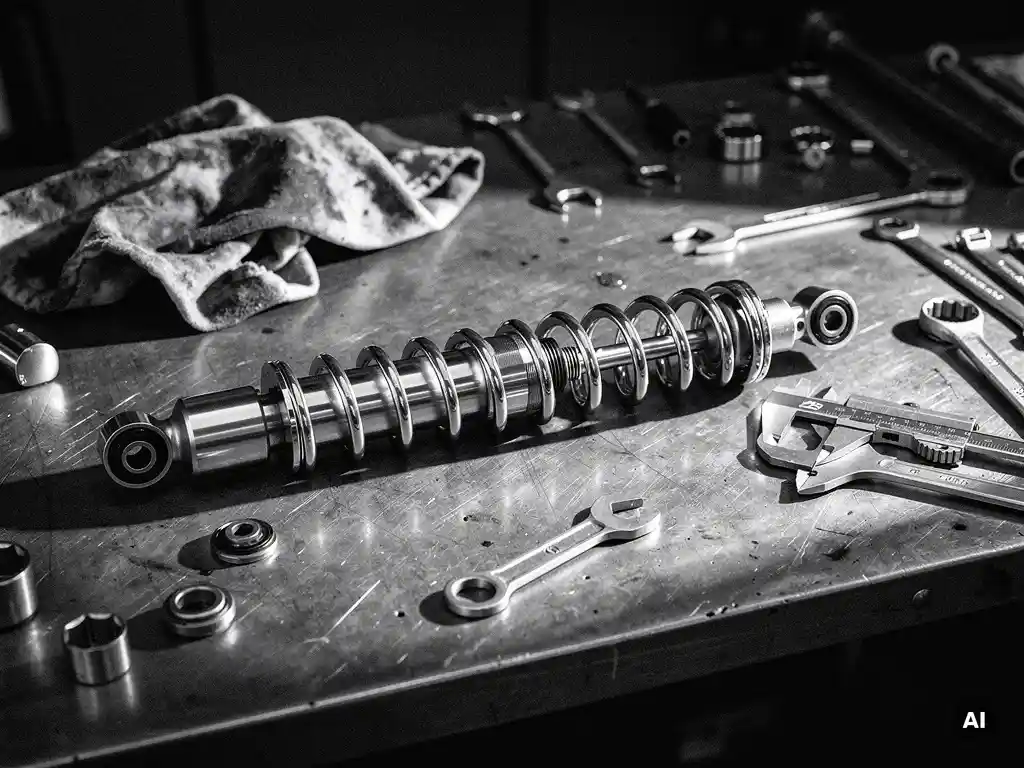
In most cases, a stiffer rear spring alone is not enough, you likely need a complete shock absorber replacement. A rear spring controls how much the suspension compresses under load, but it cannot fix worn damping, poor rebound control, or inadequate oil inside the shock body. If your suspension feels bouncy, unstable, or bottoms out repeatedly, the damper itself is the problem, not just the spring rate.
That said, there are genuine situations where a spring upgrade on its own delivers a meaningful improvement, particularly when the shock internals are still in good condition and the spring rate simply does not match your weight or riding load. The sections below unpack each question so you can make the right call for your bike and riding style.
What does a rear spring actually do compared to a shock absorber?
The rear spring and the shock absorber are two separate components that work together, but they perform entirely different jobs. The spring supports the weight of the bike, rider, and any load, determining how much the suspension compresses. The shock absorber controls the speed at which that compression and rebound happen, preventing the spring from bouncing freely.
Think of the spring as the load-bearing structure and the shock as the regulator. A spring with no damping would cause the bike to bounce continuously after every bump. A shock with no spring would offer no support at all. In most motorcycle rear suspension setups, both elements are housed together in a single unit, but they remain functionally independent.
When riders talk about improving their adventure bike suspension, they often focus on spring rate because it is the most visible variable. But the damping inside the shock body, controlled by oil, valving, and pistons, is what actually determines how planted and controlled the bike feels through corners, over rough surfaces, and during braking.
When is a stiffer rear spring enough to fix the problem?
A stiffer rear spring is enough when the shock absorber itself is mechanically sound and the only real issue is that the existing spring rate does not match your weight or load. This is a legitimate and common problem, particularly for heavier riders, those who regularly carry luggage, or anyone riding two-up on a bike with a factory spring calibrated for an average solo rider.
Signs that a spring upgrade alone may solve your issue include:
- The bike sags excessively under your weight even before you add any luggage
- Preload is already wound to its maximum and the ride height is still too low
- The shock does not feel bouncy or uncontrolled, just too soft for your load
- The shock has low mileage or has been recently serviced
- Damping adjustment (if available) still produces a noticeable and consistent response
In these cases, fitting a correctly rated rear spring, one matched to your total system weight, can restore proper sag, improve cornering geometry, and make the bike feel significantly more composed without touching the shock internals at all.
What are the signs that a full shock replacement is necessary?
A full shock replacement is necessary when the damping has degraded beyond what a spring swap can address. The most reliable indicator is that the bike feels uncontrolled or unpredictable in ways that have nothing to do with spring stiffness, particularly on rebound, where the suspension extends too quickly after compression.
Watch for these warning signs:
- Excessive bounce after bumps: The rear end continues to oscillate instead of settling quickly
- Wallowing through corners: The bike feels vague and unsettled mid-corner rather than tracking cleanly
- Bottoming out on moderate impacts: The suspension hits its travel limit on bumps that should be well within its range
- Oil seepage or visible leaks: Any fluid around the shock body means the seals have failed
- Clunking or knocking sounds: Internal wear or damage to bushings and bearings
- No response to damping adjustments: Turning the clickers produces no perceptible change in feel
For adventure and dual-sport riders covering long distances over mixed terrain, a failing shock is a safety issue, not just a comfort problem. Degraded damping reduces tire contact with the surface, which directly affects braking distance and cornering stability, especially when the bike is loaded for a multi-day trip.
What’s the difference between a progressive spring and a linear spring?
A linear spring has a constant spring rate throughout its travel, it compresses at the same resistance per millimeter from start to finish. A progressive spring has a rate that increases as it compresses, starting softer and becoming stiffer as the suspension moves deeper into its travel.
Linear springs
Linear springs are predictable and consistent, which makes them the preferred choice for performance-oriented riding and most track applications. Because the rate does not change, the bike responds uniformly to inputs, making it easier to develop feel and confidence. They are also the standard choice when a shock is professionally set up with matched damping, because the tuner can calibrate the damping precisely to a known spring rate.
Progressive springs
Progressive springs are designed to handle a wider range of loads without requiring a spring change. They ride softer when lightly loaded and firm up as load increases, which sounds ideal for adventure riders who alternate between solo riding and carrying heavy luggage. In practice, the transition between rates can feel inconsistent, and they are harder to tune precisely. They work best as a general-purpose compromise rather than a precision solution.
For serious adventure riders who want genuine performance across varied conditions, a linear spring with the correct rate for your actual riding weight, combined with properly tuned damping, will almost always outperform a progressive spring used as a one-size-fits-all fix.
Can upgrading just the spring affect handling and safety?
Yes, changing the rear spring rate affects handling in ways that go well beyond simple comfort. Spring rate directly influences ride height, chassis geometry, steering behaviour, and weight distribution, all of which have safety implications, especially at speed or on unpredictable surfaces.
A spring that is too stiff for your actual weight will keep the suspension riding high, which steepens the steering geometry and makes the front end feel nervous and quick. A spring that is too soft allows excessive sag, which slackens the geometry, slows steering response, and can cause the suspension to bottom out under braking or on rough ground.
Fitting a stiffer spring without adjusting preload, sag, or damping can also create a mismatch where the spring and shock are no longer working in the same range of travel, leading to either harsh, unresponsive behaviour early in the stroke or a sudden bottoming sensation later. Always set sag correctly after any spring change, and verify that the damping settings still suit the new spring rate.
How do you choose the right solution for your riding style and load?
The right choice depends on three variables: the current condition of your shock, your total system weight (rider plus gear plus passenger if applicable), and the type of riding you do most. Start by assessing the shock honestly before spending money on either a spring or a full replacement.
Use this framework to guide the decision:
- Check shock condition first: If the shock shows any of the failure signs listed above, a spring upgrade alone will not help. Address the shock first.
- Calculate your total riding weight: Include your body weight, full riding gear, fuel, luggage, and any passenger. Most factory springs are calibrated for a rider of around 75-80 kg with no load.
- Set and measure sag: Correct rear sag is typically 25-35 mm for road-biased adventure bikes and slightly more for off-road use. If sag is out of range even at maximum preload, the spring rate is wrong for your weight.
- Consider your terrain mix: Riders who split time between tarmac and rough off-road trails need a suspension solution that handles both, which often means a fully adjustable shock with a correctly rated spring rather than a factory unit with a stiffer spring bolted on.
- Think about serviceability: A high-quality aftermarket shock can be rebuilt and revalved as your needs change. A cheap shock with a new spring fitted on top is a short-term fix that will need replacing sooner.
For most adventure and dual-sport riders carrying varied loads across mixed terrain, the honest answer is that a complete shock upgrade delivers far more value than a spring swap alone, because it addresses damping, spring rate, and adjustability in one solution that can be tuned to your exact needs.
How TFX Suspension Helps You Find the Right Setup
We built TFX Suspension around exactly this kind of question, not just selling parts, but helping riders find the solution that genuinely fits their bike, their weight, and the way they ride. Whether you need a correctly rated rear spring, a fully rebuilt shock, or a custom-tuned unit built from scratch, we match the specification to you rather than offering a generic off-the-shelf answer.
Here is what working with us looks like in practice:
- Custom spring rate selection based on your total system weight and riding style, not factory defaults
- Full shock absorber upgrades from our Traveler, Freelexer, and Xtreme series, each designed for different performance demands, from long-distance touring to demanding off-road use
- Damping and rebound tuning matched to your specific spring rate and terrain profile
- Maintenance and rebuild services to restore or improve shocks that are worn but worth saving
- Support for a wide range of adventure and dual-sport platforms, including brands like CFMoto
If you are unsure whether you need a spring or a full shock absorber upgrade, the best first step is a conversation. Contact us directly and we will help you diagnose the real issue. You can also browse our full range of suspension solutions in the TFX shop, or learn more about our approach at tfxsuspension.com. Do not settle for standard when the right setup is within reach.
Frequently Asked Questions
How do I measure rear sag correctly, and what tools do I need?
Measuring rear sag requires a tape measure, a helper, and the bike on flat ground with the rider in full gear. Measure the distance from a fixed rear point (such as the rear axle to a point directly above it on the bodywork) in three states: fully unloaded with the rear wheel off the ground, resting on its own weight, and with the rider seated in normal riding position. Subtract the loaded measurement from the unloaded measurement to get your rider sag, which should typically fall between 25–35 mm for road-biased adventure bikes. Repeat the process after any spring change or preload adjustment to confirm the suspension is working in the correct range.
Can I damage my bike by running the wrong spring rate for too long?
Yes, running an incorrectly rated spring can cause cumulative damage over time. A spring that is too soft allows the suspension to bottom out repeatedly, which puts excessive stress on the shock internals, linkage bearings, and subframe. A spring that is too stiff transmits more impact energy directly into the chassis, accelerating wear on frame welds, swingarm pivots, and wheel bearings. Beyond mechanical wear, the handling imbalance created by a mismatched spring increases rider fatigue and reduces control in emergency situations, which is a safety risk in its own right.
Is it worth rebuilding an old shock rather than replacing it entirely?
A rebuild is worth considering when the shock body and external components are structurally sound and the unit is from a quality manufacturer that supports servicing. Rebuilding typically involves replacing seals, refreshing the oil, and sometimes revalving the internals to better suit your weight and riding style, which can restore or even improve on the original performance at a lower cost than a full replacement. However, if the shock body is corroded, the damper rod is pitted, or the unit is a low-cost OEM part not designed to be serviced, a full replacement with a quality aftermarket shock will deliver better long-term value. A suspension specialist can inspect the unit and give you an honest assessment before you commit to either route.
What happens if I upgrade the rear shock but leave the front suspension stock?
Upgrading only the rear without addressing the front can create a suspension imbalance that actually worsens handling in some situations. If the rear becomes significantly more controlled and capable, the front may now feel comparatively vague, especially under hard braking or on rough terrain where both ends need to work in sync. For riders primarily focused on load-carrying and touring, a rear upgrade alone often delivers a noticeable improvement and is a perfectly reasonable first step. But if you are pushing the bike harder off-road or on technical roads, plan to evaluate the front suspension as a follow-up, since matched front and rear performance is what produces genuinely confident handling.
How often should a rear shock be serviced, even if it doesn't show obvious signs of wear?
Most suspension manufacturers recommend a shock service every 20,000–40,000 km under normal riding conditions, though this interval shortens significantly for off-road or heavily loaded use. Shock oil degrades gradually through heat cycling and contamination, meaning damping performance declines well before visible symptoms like leaks or bouncing appear. Proactive servicing maintains consistent performance, extends the life of internal components, and gives a technician the opportunity to revalve the shock if your riding needs have changed since the last setup.
Will a stiffer rear spring make my ride harsher on rough roads?
A correctly rated stiffer spring should not make the ride harsher — it should make it more controlled. The key word is ‘correctly rated’: a spring matched to your actual system weight will bring the suspension into its proper working range, which typically improves both comfort and control because the shock is no longer being overwhelmed or underused. Harshness after a spring upgrade is usually a sign that the new spring rate is too high for the load, or that the damping settings have not been adjusted to match the new spring. Always reset sag and revisit your damping clicker settings after fitting a new spring to ensure both components are working together.
What's the most common mistake riders make when trying to fix a suspension problem themselves?
The most common mistake is treating preload as a substitute for the correct spring rate. Winding preload to its maximum does not change the spring rate — it only raises the ride height and alters the initial sag position, while the spring still compresses at the same rate per millimetre. Riders who max out preload trying to compensate for an undersized spring end up with poor ride quality and a shock working in the wrong part of its travel. The correct fix is a spring with a rate matched to your weight, set with preload used only for fine-tuning sag within a few millimetres of the target.
Configure Your Motorcycle Suspension
Find the correct TFX suspension setup for your motorcycle in less than 60 seconds.
Start Configuration