

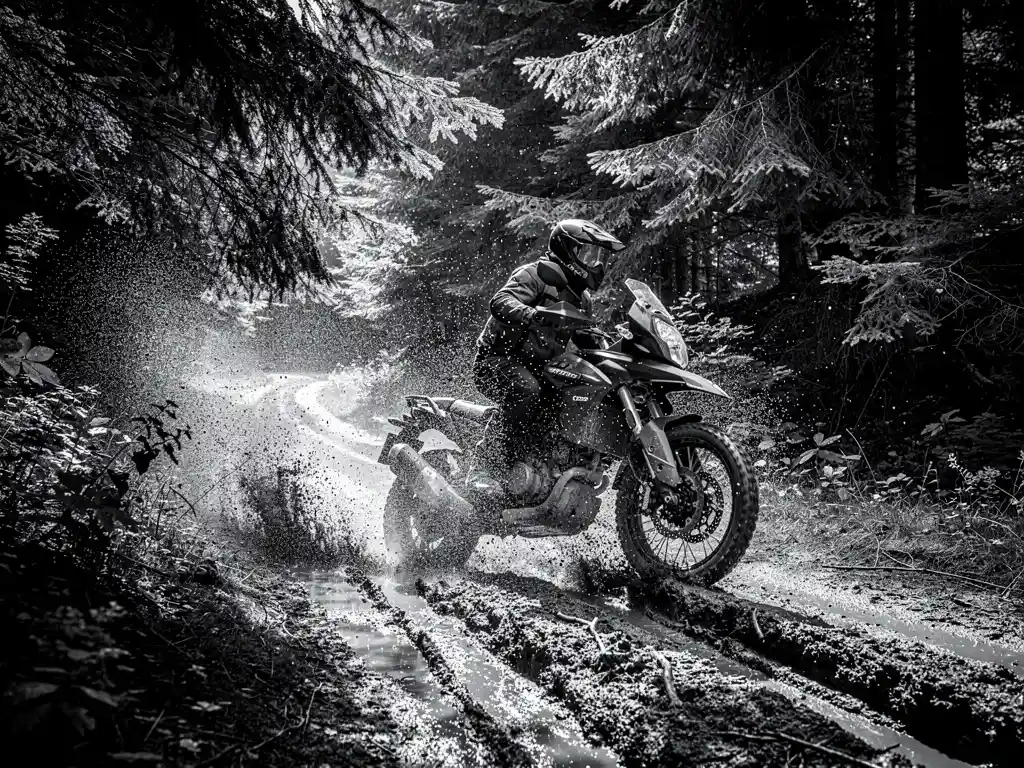
The CFMOTO 450 MT handles a wet forest track with moderate capability but clear limitations. Its stock suspension and road-biased tyre setup mean it copes reasonably well on hardpack with light moisture, but deep mud, standing water, and slippery roots quickly expose the boundaries of its factory configuration. Riders who understand those limits and prepare accordingly will have a far safer and more enjoyable experience on rain-soaked trails.
What makes the CFMOTO 450 MT suspension struggle on wet forest tracks?
The CFMOTO 450 MT suspension struggles on wet forest tracks primarily because its factory setup is tuned for a balance between road comfort and light off-road use, not for the unpredictable, high-demand conditions of a saturated trail. The front forks and rear shock lack the damping range needed to absorb sudden, irregular impacts that become far more frequent when the ground turns soft and slippery.
On a dry trail, the 450 MT’s suspension can mask some of its limitations because the ground provides consistent feedback. Add heavy rain and the picture changes fast. Roots become slick, ruts fill with water, and the surface shifts between firm and completely soft within a few metres. The stock damping settings cannot adapt quickly enough to these transitions, causing the front end to deflect unpredictably and the rear to skip rather than track.
The spring rates on the CFMOTO 450 MT adventure bike are also set for an average rider weight without luggage. The moment you add even a small pack for a day ride, the rear sags further than intended, reducing ground clearance and changing the bike’s steering geometry in a way that makes slow-speed technical riding noticeably harder in wet conditions.
How does the CFMOTO 450 MT handle mud and standing water?
The CFMOTO 450 MT handles light mud and shallow standing water reasonably well for a dual sport bike in its class, but it struggles significantly in deep, sticky mud or water crossings above ankle depth. The parallel-twin engine’s torque delivery is manageable, but the stock tyres and suspension combination means momentum is easily lost, and recovery from a slide requires confident, active rider input.
In standing water, the main concern is not mechanical damage but loss of traction and visibility of the trail surface beneath. What looks like a shallow puddle on a forest track can conceal a deep rut or a submerged root. The 450 MT’s relatively modest ground clearance compared to dedicated enduro machines means the undercarriage can catch on hidden obstacles more easily than riders expect.
Mud behaviour depends heavily on its consistency. Thin, watery mud on a firm base is manageable. Thick, clay-heavy mud that packs into the tyre tread is where the CFMOTO 450 MT off road bike shows its limits most clearly. Traction drops sharply, the bike becomes heavy to steer, and the stock tyres fill up quickly, leaving little grip between the rubber and the trail surface.
What tyre setup works best for the 450 MT in wet off-road conditions?
For wet off-road conditions, the best tyre setup for the CFMOTO 450 MT is a dedicated dual sport or enduro tyre with an open, aggressive tread pattern that can self-clean in mud. Stock tyres on the 450 MT are a compromise between road and off-road performance, and they are the single most impactful upgrade you can make before heading onto wet forest trails.
Look for tyres with a 50/50 or 60/40 off-road bias if you are mixing forest trails with road transfers. A tyre like the Mitas E-07+ or Shinko 705 offers significantly improved wet off-road grip while remaining road-legal and comfortable on tarmac. If your riding is predominantly off-road, moving toward a more aggressive 70/30 or 80/20 tyre will give you noticeably better traction in mud and on wet roots.
Tyre pressure also plays a meaningful role on wet trails. Dropping pressure slightly from the standard road setting increases the contact patch and allows the tyre to conform better to uneven, soft surfaces. Many experienced adventure and dual sport riders drop to around 1.5 to 1.8 bar off-road, then reinflate before returning to tarmac. Always check the manufacturer’s minimum pressure guidance before adjusting.
Does the CFMOTO 450 MT suspension need upgrading for serious off-road riding?
Yes, the CFMOTO 450 MT suspension benefits significantly from an upgrade if you plan to ride seriously off-road, particularly on wet or technical terrain. The factory components are adequate for occasional light trails and mixed road use, but they lack the adjustability, damping quality, and spring rate precision needed for consistent performance on demanding forest tracks.
The most noticeable gain comes from replacing the rear shock. The stock unit has limited adjustment and a spring rate that suits a narrow range of rider weights and load conditions. A quality aftermarket shock with preload, compression, and rebound adjustment allows you to dial in the setup for your weight, your luggage, and the specific terrain you are riding.
Front fork improvements are also worthwhile, though often more involved. Options range from a quality fork spring kit matched to your weight through to more comprehensive damping upgrades. For many riders, starting with the rear shock and adding a fork spring kit is a practical and cost-effective first step before committing to a full front end overhaul.
The CFMOTO Ibex 450 shares its fundamental suspension architecture with the 450 MT, so the same upgrade logic applies across both models. Riders moving from recreational trail use to longer, more demanding off-road tours will consistently report that suspension quality is the area where the investment delivers the most tangible improvement in confidence and control.
How should you adjust the 450 MT’s suspension settings before a wet forest ride?
Before a wet forest ride on the CFMOTO 450 MT, you should check rear preload if you are carrying luggage, adjust rebound damping where the stock shock allows it to help the suspension recover faster over successive obstacles, and verify that sag is set correctly for your loaded weight. These adjustments help the bike stay composed on unpredictable, soft terrain.
Start with sag. Rider sag on a dual sport or adventure bike should typically fall between 95 and 110 mm at the rear when you are sitting in riding position with your gear on. If your sag is significantly more than this, add preload. If it is less, reduce it. Correct sag ensures the suspension operates in the middle of its travel range, giving you both bump absorption and the ability to extend over dips.
Rebound damping is often overlooked but matters enormously on wet trails. If rebound is set too slow, the suspension packs down over successive bumps and runs out of travel. If it is too fast, the rear kicks and loses contact with the ground. For wet, rooty forest tracks, erring slightly toward faster rebound helps the tyre stay in contact with the surface through rapid, irregular terrain changes.
If the 450 MT’s stock shock offers limited adjustment, note the settings you start with and make one change at a time. Even small adjustments have a noticeable effect on wet terrain where the margin for error is smaller than on dry trails.
What are the biggest safety risks riding the CFMOTO 450 MT on rain-soaked trails?
The biggest safety risks riding the CFMOTO 450 MT on rain-soaked trails are sudden front wheel washout, rear traction loss on off-camber sections, reduced visibility of trail hazards beneath standing water, and fatigue from the increased physical effort required to control the bike on soft ground. Each of these risks is manageable with the right preparation and riding technique.
Front wheel washout is the most common cause of falls on wet forest trails. It happens when the front tyre loses grip mid-corner, usually on wet roots, leaf litter, or slick clay. Keeping your weight central to slightly rearward, looking ahead to choose the best line, and avoiding sharp braking while turning significantly reduces this risk.
Off-camber sections are particularly hazardous after rain because the bike’s weight naturally wants to slide downhill, and the reduced traction gives the tyres less resistance to that slide. Slow, deliberate throttle application and keeping your outside foot down for balance are key techniques here.
Fatigue is an underestimated risk on wet rides. Controlling a bike on slippery terrain demands constant active input, and tiredness leads to slower reactions and worse decision-making. Plan shorter distances for wet off-road stages than you would on dry trails, and build in more rest stops than you think you need.
How TFX Suspension Helps With CFMOTO 450 MT Off-Road Performance
We specialise in custom suspension solutions that directly address the limitations the CFMOTO 450 MT shows on wet forest tracks and demanding off-road terrain. Rather than offering generic upgrades, we build and tune suspension systems matched to your specific weight, riding style, load requirements, and the terrain you actually ride. Here is what we provide for 450 MT and CFMOTO Ibex 450 riders:
- Custom-tuned rear shocks with preload, compression, and rebound adjustment, built to the correct spring rate for your weight and luggage setup
- Front fork spring kits and damping upgrades that transform the 450 MT’s front end response on technical, wet terrain
- Personalised suspension setup advice based on your riding profile, so every adjustment is purposeful rather than guesswork
- Maintenance and rebuild services to keep your suspension performing at its best across the life of the bike
- A full range of CFMOTO-compatible components available through our online shop
If you are serious about getting the most from your CFMOTO 450 MT adventure bike off-road, the right suspension makes every wet trail safer and more enjoyable. Browse our CFMOTO suspension range, explore the full TFX suspension shop, or use our vehicle finder tool to see exactly what fits your bike. Visit TFX Suspension to get started with a setup built around your riding, not around an average.
Frequently Asked Questions
Can I ride the CFMOTO 450 MT on wet forest tracks without any modifications?
Yes, you can ride the 450 MT on wet forest tracks in its stock form, but you should go in with realistic expectations. The bike handles light mud and damp hardpack reasonably well, but you will need to ride more conservatively, choose smoother lines, and avoid deep mud or water crossings above ankle depth. The most impactful pre-ride change you can make without any permanent modification is simply dropping your tyre pressure to around 1.5–1.8 bar, which meaningfully improves grip on soft, uneven surfaces.
What is the best way to get started with upgrading the 450 MT for off-road use without spending a lot at once?
Start with tyres — it is the single highest-return upgrade for wet off-road riding and one of the most affordable. Switching from the stock road-biased rubber to a 50/50 dual sport tyre like the Mitas E-07+ will transform how the bike feels on slippery trails. Once tyres are sorted, the next logical step is a custom-tuned rear shock matched to your weight, which addresses the sag and damping limitations that become most apparent on technical, wet terrain.
How do I know if my 450 MT's suspension sag is set correctly before heading out?
Measure rear sag with your full riding gear on and any luggage you plan to carry. Sit in your normal riding position on the bike with a friend holding it upright, and have them measure the distance between two fixed points on the rear end — typically between the rear axle and a point on the subframe directly above it — then compare this to the unloaded measurement. The difference should fall between 95 and 110 mm for a dual sport or adventure bike like the 450 MT. If sag exceeds this range, add preload; if it is too little, reduce it.
Are there any common mistakes riders make when taking the 450 MT onto wet trails for the first time?
The most common mistake is underestimating how quickly conditions change on a wet forest track — what starts as a manageable damp trail can become a very different challenge within a few hundred metres as the ground softens. Riders also frequently carry too much speed into corners on wet roots or leaf litter, where front washout risk is highest. A third common error is ignoring tyre pressure; leaving it at road settings significantly reduces the contact patch and grip available on soft ground.
Does the CFMOTO Ibex 450 have the same off-road wet weather limitations as the 450 MT?
Yes, the Ibex 450 shares the same fundamental suspension architecture as the 450 MT, so it faces very similar limitations on wet, technical terrain — the same spring rate constraints, damping range, and sensitivity to rider weight and luggage apply. The same upgrade approach works across both models, including custom rear shocks, fork spring kits, and tyre changes. If you are riding an Ibex 450 on demanding off-road terrain, the same preparation and setup advice in this post applies directly to your bike.
How much does rider technique matter compared to bike setup on wet forest trails?
Both matter significantly, but technique can compensate for equipment limitations more than equipment can compensate for poor technique. Keeping your weight active and central, looking well ahead to pick clean lines, using smooth and progressive throttle inputs, and avoiding braking mid-corner will all reduce your fall risk regardless of what tyres or suspension you are running. That said, even the best technique has limits on stock suspension and road tyres in deep mud — at a certain point, the right equipment genuinely makes the bike safer and less exhausting to ride.
How often should I service the 450 MT's suspension if I regularly ride in wet and muddy conditions?
Wet and muddy riding accelerates wear on fork seals, bushings, and shock internals significantly faster than road use. As a general guideline, fork seals and oil should be inspected every 40–60 hours of off-road riding in wet conditions, and the rear shock should be serviced at least once a season if you ride trails regularly. Mud and water ingress past worn seals degrades damping performance gradually, so the bike may feel noticeably worse before a seal failure makes the problem obvious — regular maintenance keeps performance consistent and prevents more costly damage.
Configure Your Motorcycle Suspension
Find the correct TFX suspension setup for your motorcycle in less than 60 seconds.
Start Configuration