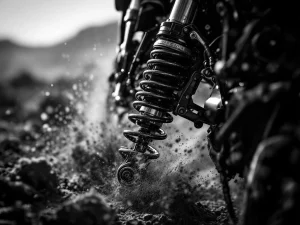
Incorrect sag settings on your adventure bike create serious handling and safety issues. Too little sag makes the ride harsh and skittish, killing traction on rough terrain while exhausting you faster. Too much sag causes wallowing through corners, frequent bottoming out, and reduced ground clearance. Both extremes accelerate wear on suspension components, tyres, and even your frame. Your bike will signal problems through harsh impacts, vague handling, unusual fatigue, and uneven tyre wear. Getting sag right protects your investment and transforms how your adventure bike performs across all terrain.
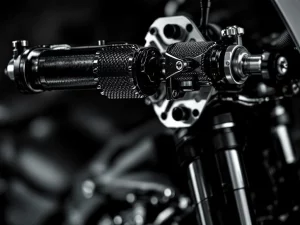
A steering damper controls unwanted handlebar movement on adventure motorcycles, reducing dangerous tank slappers and improving stability on rough terrain and at high speeds. It works like a shock absorber for your handlebars, resisting sudden jerks when you hit rocks, ruts, or obstacles. Most beneficial for riders who tackle off-road terrain, tour with heavy luggage, or ride at motorway speeds, steering dampers only intervene during rapid movements while allowing normal steering freedom. Discover how they work and whether your adventure bike needs one.
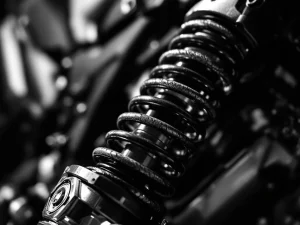
Progressive springs for adventure bikes feature variable coil spacing that creates a spring rate increasing with compression—soft for small bumps, firm for hard impacts. Unlike linear springs with constant rates, they adapt automatically to changing loads and terrain without adjustment. This makes them ideal for riders switching between solo touring and fully-loaded trips, or mixing tarmac with off-road riding. They provide comfort over minor obstacles while preventing bottoming out during significant impacts, offering versatility that suits the varied conditions adventure riders encounter.
Nitrogen-charged shocks use pressurised gas to keep damping oil stable and prevent aeration during compression. For adventure motorcycles, this technology delivers consistent suspension performance across varied terrain, temperatures, and long distances. Unlike standard oil shocks that fade with heat and repeated use, nitrogen-charged systems maintain predictable handling whether you’re on tarmac or tackling rocky trails. Learn how this suspension technology works and why it’s become essential for serious adventure riding.
Struggling with harsh bottoming, excessive brake dive, or poor traction despite adjusting your adventure bike’s suspension settings? Revalving changes your suspension’s internal damping characteristics to match your actual riding style, weight, and terrain. Unlike external adjusters that work within fixed limits, revalving fundamentally alters how your suspension controls movement. If you frequently ride two-up, carry heavy luggage, or can’t find settings that feel right, custom valving might be the solution you need.
More suspension travel doesn’t automatically mean better performance for your adventure motorcycle. While longer travel helps absorb bigger impacts, it can raise your centre of gravity, slow handling, and add weight. Real-world performance depends on damping quality, spring rates, and proper tuning—not just travel numbers. Discover why 170mm of well-configured suspension outperforms 230mm of poorly set-up travel, and learn how to match suspension specs to your actual riding conditions rather than imagined adventures.
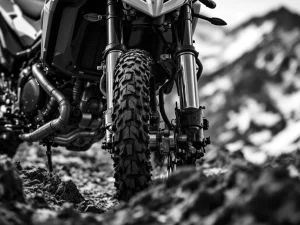
Modern adventure motorcycles increasingly feature inverted forks for superior handling and rigidity. Popular models like the BMW R 1250 GS, KTM 890 Adventure, Yamaha Ténéré 700, and Ducati Multistrada come standard with this technology. These upside-down forks deliver improved steering precision, better heat dissipation, and enhanced performance across varied terrain. While not essential for every rider, inverted forks offer tangible benefits for aggressive riding, technical off-road sections, and heavy touring loads. Proper suspension setup matters more than fork type alone.
Wheel travel and suspension travel aren’t the same thing on your adventure motorcycle. Wheel travel measures the vertical distance your wheel moves from fully extended to fully compressed, while suspension travel measures shock absorber compression. These numbers differ because of linkage ratios in your suspension system. Understanding both measurements helps you optimize setup for different terrain, improve traction and control, and choose the right shock settings. Most adventure bikes use progressive linkages where the ratio changes throughout the travel range, affecting small bump sensitivity and bottoming resistance.
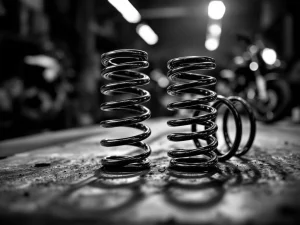
Linear springs compress at a constant rate, offering predictable suspension behavior throughout their travel. Progressive springs feature variable coil spacing that starts soft for small bumps and firms up under heavy loads. Your choice impacts how your adventure bike handles everything from smooth tarmac to technical off-road terrain. Understanding the differences helps you select suspension that matches your riding style, typical load, and the surfaces you encounter most. Whether you prioritize comfort, versatility, or precise feedback, the right spring type transforms your riding experience.
Suspension stiction creates that harsh, unresponsive feeling when your adventure bike hits small bumps. This static friction prevents smooth suspension movement, reducing traction and control on technical terrain. Caused by dirty seals, worn bushings, and contaminated oil, stiction is especially problematic for adventure riders facing dust, mud, and extreme conditions. Discover how to identify stiction through simple tests, understand what causes it, and learn practical maintenance techniques to keep your suspension performing smoothly on every adventure.