

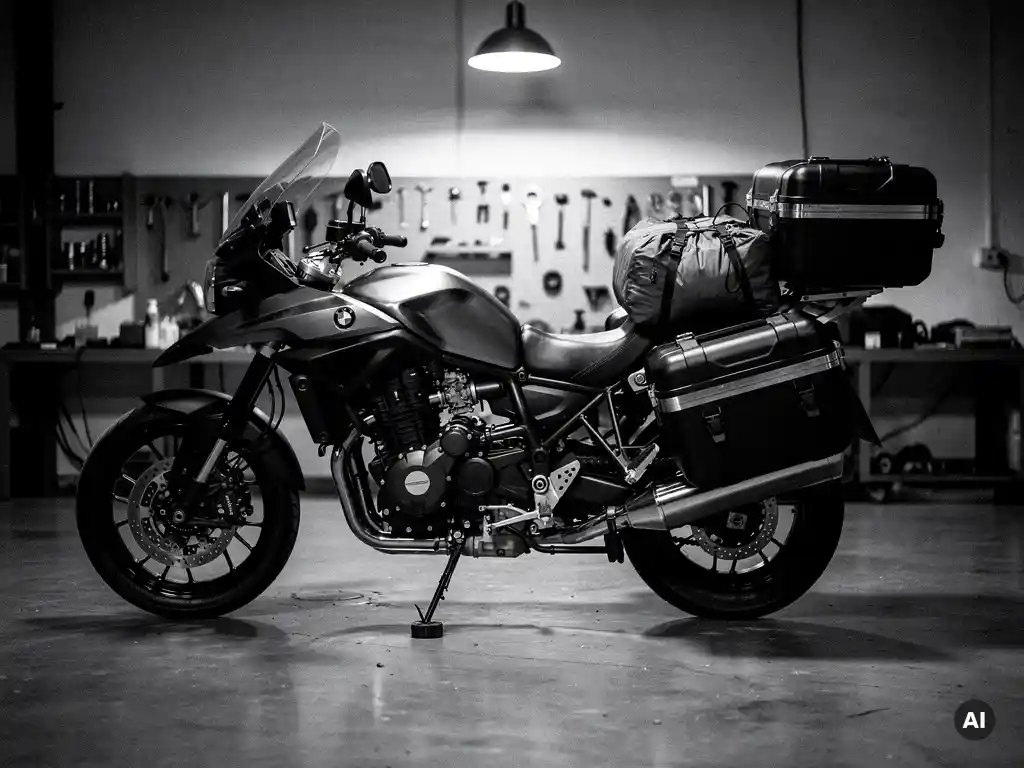
Yes, smarter luggage distribution can reduce or even eliminate the need for a stiffer spring in many cases. When weight is spread more evenly across the motorcycle, the rear suspension is no longer forced to compensate for concentrated loads, which means your existing spring rate may perform far better than you expect. This article walks through how weight placement works, which setups cause the most damage, and when redistribution alone is no longer enough.
How does luggage weight distribution affect your suspension?
Luggage weight distribution directly affects how much force is applied to your suspension components, particularly the rear shock. When heavy loads sit far back or high up on the bike, they create leverage that amplifies the effective weight the rear spring must manage, reducing suspension travel and making the ride feel stiffer, less responsive, and harder to control.
Every kilogram you add to the rear of an adventure bike acts like a lever. The further the weight sits behind the rear axle, the more rotational force it creates around that pivot point. This is why a 10 kg tail bag can feel dramatically heavier to the suspension than a 10 kg tank bag sitting close to the center of gravity.
The consequences go beyond comfort. When the rear suspension is overloaded, it rides lower in its travel range, which reduces the available suspension stroke for absorbing bumps. The front end lightens as a result, reducing steering precision and front wheel traction. On mixed terrain, this imbalance becomes a genuine safety concern, not just a comfort issue.
The key principle is simple: weight that sits low, centered, and close to the axles places the least stress on your suspension system. Weight that sits high, far back, or far forward forces the suspension to work harder to maintain balance and control.
What types of luggage setups put the most stress on rear suspension?
The luggage configurations that put the greatest stress on rear suspension are large top cases mounted high above the seat, heavily loaded tail bags, and rear-heavy pannier setups where most of the weight is packed into the left and right bags without balancing it with front storage. These setups combine high mounting positions with rearward weight bias, which is the worst combination for suspension load.
High-mounted top cases and tail bags
A top case mounted on a luggage rack sits well above the rear axle and behind the seat. When loaded with camping gear, tools, or clothing, it raises the center of gravity and pushes weight rearward simultaneously. The rear shock must not only support the extra mass but also manage the increased pendulum effect during cornering and acceleration.
Unbalanced pannier loading
Hard panniers are often praised for their low and wide mounting position, which is generally good for handling. However, when riders pack them unevenly, or load them exclusively with heavy items while leaving the front of the bike empty, they still create a rear-heavy bias. The suspension has to compensate for the imbalance, which accelerates wear on the rear spring and damper.
Can smarter packing actually prevent the need for a stiffer spring?
Yes, smarter packing can genuinely prevent the need for a stiffer spring, provided your total load remains within a reasonable range for your current spring rate. By moving heavy items closer to the center of the bike, packing low, and using front storage to balance rear weight, you reduce the effective load the rear suspension experiences and restore the spring’s ability to perform within its intended range.
The practical steps that make the biggest difference are:
- Pack the heaviest items in your panniers, not your top case. Dense items like tools, spare parts, and food should sit low and close to the axle rather than high on a rack.
- Use a tank bag for dense, compact items. A tank bag sits directly over the center of gravity and distributes weight toward the front, counterbalancing rear loads effectively.
- Distribute weight evenly left to right. Uneven side-to-side loading creates handling asymmetry that the suspension cannot correct on its own.
- Keep your top case light. Reserve it for lightweight, bulky items like rain gear, a jacket layer, or a sleeping bag. Avoid using it as general overflow storage for heavy gear.
- Minimize rack-mounted dry bags. Soft luggage piled on a rear rack is one of the most common causes of unnecessary rear suspension stress on adventure bikes.
Riders who reorganize their packing this way often report a noticeably more planted rear end, better steering feel, and improved comfort over rough surfaces, all without touching the suspension setup at all. The spring was always capable, but the loading pattern was working against it.
When does luggage redistribution stop being enough?
Luggage redistribution stops being enough when the total carried weight consistently exceeds what your current spring rate was designed to handle, or when the nature of your riding involves sustained off-road use, a passenger, or loads that cannot physically be moved closer to the center of the bike. At that point, the spring itself needs to change.
A few clear indicators that redistribution alone will not solve the problem:
- The rear of the bike sags noticeably even after rebalancing your load
- You regularly ride two-up with luggage, which adds significant combined weight regardless of how it is distributed
- Your suspension bottoms out on moderate bumps even with a well-organized setup
- You frequently ride heavily loaded on technical off-road terrain where suspension travel is critical for safety
- Your bike’s sag measurement falls well outside the recommended range after packing, even with the lightest possible configuration
Spring rate is matched to a weight range. If your total system weight, meaning rider, gear, and luggage, consistently sits above the upper end of that range, no amount of clever packing will bring the spring back into its optimal operating window. This is the point where a spring upgrade or a fully custom suspension setup becomes necessary rather than optional.
What suspension adjustments complement a better luggage layout?
Once you have optimized your luggage layout, the suspension adjustments that complement it most effectively are preload, rebound damping, and compression damping, applied in that order. Preload sets the ride height and sag for your actual loaded weight. Rebound controls how quickly the shock extends after compression. Compression damping determines how the shock responds to impacts.
Start with preload. After reorganizing your luggage and loading the bike as you would for a real trip, measure rear sag with you on the bike in full riding gear. Most adventure bikes perform best with a sag of around 30 to 35 mm, though this varies by model and riding style. Adjust preload until you are in that range.
With preload set correctly, assess rebound. If the rear of the bike feels like it bounces or kicks after hitting a bump, the rebound is too fast. Slow it down in small increments and test again. On the other hand, if the suspension feels like it is packing down and getting stiffer over successive bumps, the rebound is too slow.
Compression damping is the final layer. This setting affects how the suspension handles sharp impacts and high-speed terrain. On smoother roads with a well-distributed load, you may need less compression damping than on rough off-road trails. Adjust based on the terrain you spend the most time on, not the most extreme conditions you occasionally encounter.
These three adjustments work together. Changing one affects how the others feel, so approach each change methodically and test in real conditions before making further adjustments.
How TFX Suspension Helps With Adventure Bike Loading and Spring Setup
We understand that adventure riding rarely involves a single, predictable load. Your bike carries different weights across different routes, and your suspension needs to handle all of it without compromise. That is exactly what we build for. At TFX Suspension, we offer solutions that address the full picture of adventure bike suspension, not just the spring in isolation:
- Custom spring rates matched to your actual rider weight, typical luggage load, and riding style, so your suspension performs optimally across the range of conditions you actually ride in
- Fully adjustable shock units from our Traveler and Freelexer series, giving you the flexibility to fine-tune preload, rebound, and compression as your load changes from day to day
- Personal suspension tuning where we assess your setup, your packing habits, and your riding profile to recommend the exact configuration that works for your specific situation
- Compatibility across a wide range of adventure bikes, including popular platforms from manufacturers like CFMoto
If you have already optimized your luggage layout and still feel like your suspension is not keeping up, or if you want to build a setup that handles every load scenario from the start, we are here to help. Get in touch with us directly to discuss your riding situation, browse our full range of suspension products, or visit TFX Suspension to learn more about what we build and why.
Frequently Asked Questions
How do I know if my current spring rate is the right starting point before I try reorganizing my luggage?
The quickest way to check is to measure your static and rider sag with the bike unloaded and then again with you on it in full riding gear but no luggage. If your sag figures are already at or beyond the upper end of the recommended range before you add a single bag, your spring rate is likely too soft for your rider weight and no amount of luggage redistribution will fully compensate. If sag is within range unloaded, redistribution is a very reasonable first step before considering a spring change.
What is the best way to check whether my luggage redistribution has actually improved my suspension performance?
After repacking, measure your rear sag again with the bike fully loaded as you would ride it, then take the bike on a familiar road or trail and pay attention to three things: how planted the rear feels under acceleration, how quickly the front responds to steering inputs, and whether the suspension bottoms out on bumps it previously struggled with. If sag has moved closer to the 30–35 mm target range and the bike feels more balanced and responsive, your redistribution has worked. If sag is still excessive and handling still feels vague or heavy at the rear, a spring rate change is likely the next step.
Can I use luggage redistribution as a long-term fix, or is it just a temporary workaround?
For riders whose total system weight, meaning rider, gear, and luggage, falls within the intended range of their stock spring, smarter packing is a genuine long-term solution, not just a patch. The problem in many cases is not an inadequate spring but a loading pattern that works against it. However, if your riding consistently involves heavy loads, two-up riding, or technical off-road terrain, redistribution should be seen as a complementary habit rather than a substitute for a properly rated spring.
Are there specific items that most riders pack incorrectly and that make the biggest difference when moved?
Tools and spare parts are the most commonly misplaced heavy items, as riders often toss them into a top case or tail bag for easy access when they should sit as low and as close to the axle as possible, ideally inside panniers near the base. Water, food, and camera equipment are also frequent offenders. Moving just these dense, compact items from a rear rack or top case into lower pannier pockets or a tank bag can produce a noticeable improvement in how the rear suspension behaves, often without any other changes.
What happens if I adjust preload to compensate for a poor luggage layout instead of repacking first?
Increasing preload to mask a rear-heavy load is a common mistake that treats the symptom rather than the cause. While it can restore ride height temporarily, it raises the spring’s baseline tension without addressing the leverage and weight bias created by poor luggage placement, which means rebound and compression behavior will still be compromised. You may also end up with a setup that rides acceptably when loaded but feels harsh and unresponsive when you remove luggage, because the preload is now too high for the reduced weight. Always optimize your luggage layout before making suspension adjustments.
Does luggage weight distribution matter as much on tarmac as it does off-road?
It matters on both surfaces, but the consequences are more immediate and safety-critical off-road. On tarmac, a rear-heavy setup typically shows up as vague steering, mild instability under braking, and a slightly harsher ride, which are noticeable but manageable at moderate speeds. Off-road, the same imbalance reduces available suspension travel precisely when you need it most, making the bike more likely to deflect on rough terrain, lose front wheel traction, and feel unpredictable mid-corner. If you ride any mixed terrain at all, luggage distribution should be treated as a handling priority, not just a comfort consideration.
Is there a simple rule of thumb for how to split weight between front and rear storage when touring?
A practical starting point is to aim for roughly 60% of your luggage weight in your panniers, 20–25% in a tank bag or frame-mounted front storage, and no more than 15–20% in a top case or tail bag, keeping the lightest and bulkiest items at the rear. This is not a rigid formula, as bike geometry and luggage system design vary, but it reflects the general principle of keeping mass low, centered, and balanced front to rear. Once you have a rough split in place, use your sag measurement and on-road feel to fine-tune from there.
Configure Your Motorcycle Suspension
Find the correct TFX suspension setup for your motorcycle in less than 60 seconds.
Start Configuration